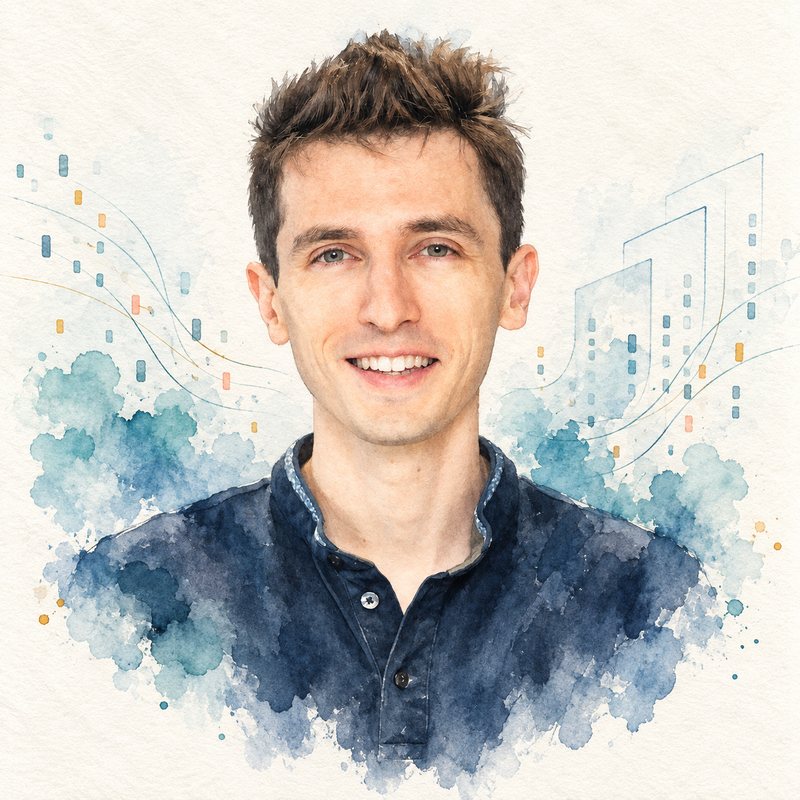
Guillaume Lample
Co-founder and Chief Science Officer, Mistral AI
FAIR researcher behind unsupervised translation and the first LLaMA models, now Mistral AI's chief scientist.
Guillaume Lample graduated from École polytechnique and took a master's in AI at Carnegie Mellon, where in 2016 he was first author of a paper on neural networks for recognizing names of people, places and organizations in text. He then joined Facebook AI Research in Paris. With Alexis Conneau, Ludovic Denoyer and Marc'Aurelio Ranzato he showed in 2017 and 2018 that a system could learn to translate between two languages from monolingual text alone, with no parallel translations to learn from, and in January 2019 he and Conneau published XLM, a way of pretraining one language model across many languages.
His most unexpected result came in December 2019, when he and François Charton trained a sequence-to-sequence network to integrate functions and solve differential equations, treating mathematics as translation between strings of symbols. They reported that it outperformed Mathematica and Matlab on their test problems. In May 2022 he led HyperTree Proof Search, a system that proved theorems in formal mathematics, and then joined the team that built LLaMA, Meta's family of efficient language models released to researchers in February 2023; he is its last-listed author.
In spring 2023 Lample left Meta with his LLaMA colleague Timothée Lacroix and Arthur Mensch of DeepMind, friends since their student days, to found Mistral AI in Paris. As chief science officer he leads the teams that train Mistral's models, which have run from Mistral 7B in September 2023 and the Mixtral mixture-of-experts models to Mistral Large 3, released with open weights in December 2025. Mistral's own 2026 speaker biography describes him as leading "the science teams driving the development of cutting-edge AI models." In 2024 Mistral's chief business officer, Florian Bressand, told CNBC that more than half the team that built Llama now worked at Mistral.
Known for
Unsupervised machine translation
Papers in 2017 and 2018 showed that translation systems could be trained from monolingual text in each language, without sentence pairs, useful for languages with few translated texts.
Deep learning for symbolic mathematics
With François Charton, trained transformers to integrate functions and solve differential equations, reporting better results than commercial computer algebra systems on the tested problems.
LLaMA and Mistral's models
Co-author of Meta's first LLaMA models (2023) and scientific lead for Mistral's open-weight and commercial models since.
Career
-
until 2023
Research scientist, Facebook AI Research (Paris)
-
2023-present
Co-founder and Chief Science Officer
Sources
- Guillaume Lample, speaker biography (AI Now Summit, Mistral AI, May 2026)
- About Mistral, founders and key dates (Mistral AI)
- Neural Architectures for Named Entity Recognition (Lample et al., arXiv, 2016)
- Unsupervised Machine Translation Using Monolingual Corpora Only (Lample et al., arXiv, 2017)
- Deep Learning for Symbolic Mathematics (Lample and Charton, arXiv, December 2019)
- HyperTree Proof Search for Neural Theorem Proving (Lample et al., arXiv, May 2022)
- LLaMA: Open and Efficient Foundation Language Models (Touvron et al., arXiv, February 2023)
- France's Mistral AI blows in with a 113 million dollar seed round (TechCrunch, June 2023)
- Introducing Mistral 3 (Mistral AI, December 2025)
- Mistral AI's CEO on Microsoft, regulation and Europe's AI ecosystem, citing CNBC (TIME, August 2024)
Brief profiles cover a person's professional record: roles, work and public statements, each from a source listed here. Full profiles, with positions across the debates, are kept for the people the site follows most closely.