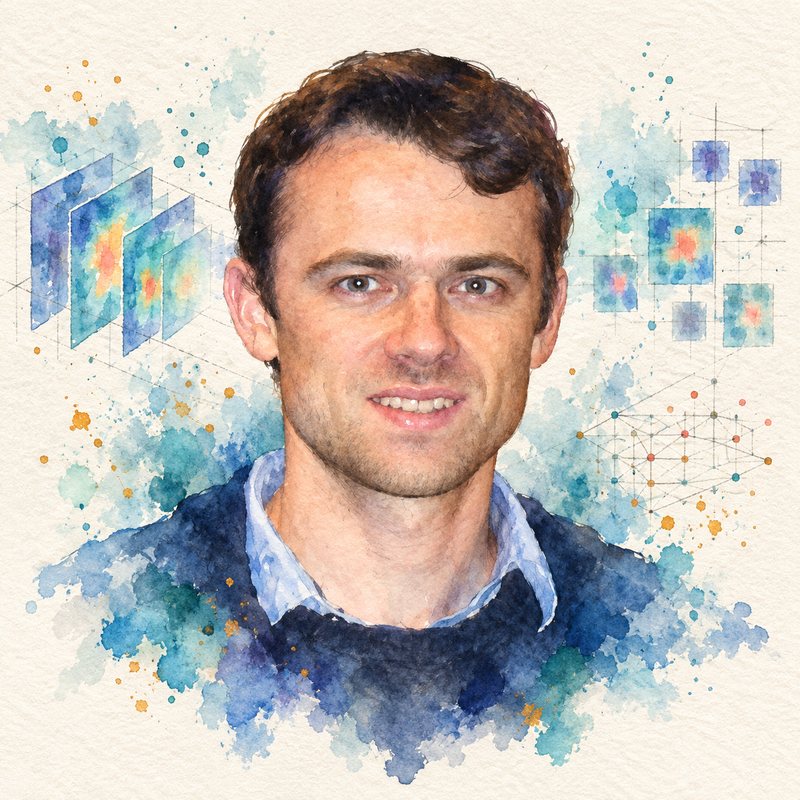
Rob Fergus
Head of FAIR (Fundamental AI Research), Meta
Co-founded Facebook AI Research with Yann LeCun, spent five years at DeepMind, and returned to run FAIR in 2025.
Rob Fergus studied electrical engineering with Pietro Perona at Caltech and took a PhD with Andrew Zisserman at Oxford in 2005, then spent two years as a postdoc in William Freeman's group at MIT before joining New York University's Courant Institute, where he and Yann LeCun built the CILVR lab. His early work was in computer vision. With his student Matthew Zeiler he published "Visualizing and Understanding Convolutional Networks" in 2013, a method for seeing what each layer of a trained image classifier responds to, which the pair used to design a network that beat the 2012 ImageNet winner. The same year he was a co-author of "Intriguing properties of neural networks," the paper that first described adversarial examples, images changed imperceptibly so that a network misclassifies them.
When Facebook hired LeCun to start an AI lab in December 2013, Fergus co-founded it with him, and at FAIR he worked on memory-augmented networks, including End-to-End Memory Networks in 2015. His NYU PhD students went on to found or co-found Clarifai (Zeiler), OpenAI (Wojciech Zaremba), Perplexity (Denis Yarats) and EvolutionaryScale (Alex Rives).
He spent about five years as a research director at Google DeepMind before Meta named him head of FAIR in May 2025, succeeding Joëlle Pineau. LeCun announced the appointment by writing that FAIR was "refocusing on Advanced Machine Intelligence: what others would call human-level AI or AGI." Weeks later Meta folded FAIR into Meta Superintelligence Labs under Alexandr Wang, and the October 2025 cuts of about 600 jobs in Meta's AI division reached FAIR. LeCun left at the end of 2025, leaving Fergus as the senior figure of Meta's original research lab.
Known for
Visualizing convolutional networks
The 2013 deconvolution technique with Matthew Zeiler showed which input patterns drive each layer of an image network and became a standard tool for interpreting vision models.
Adversarial examples
Co-author of the 2013 paper showing that tiny, targeted changes to an image can make a neural network misclassify it, which started a large body of research on attacking and defending neural networks.
End-to-End Memory Networks
A 2015 FAIR model, with Sainbayar Sukhbaatar, Arthur Szlam and Jason Weston, that read from an external memory with several rounds of attention and, unlike earlier memory networks, needed no supervision of which memories to use.
Career
-
New York University
Professor of Computer Science, Courant Institute; co-founder of the CILVR lab
-
2013-2020
Co-founder and research scientist, Facebook AI Research
-
2020-2025
Research director
-
2025-present
Head of FAIR, within Meta Superintelligence Labs
Sources
- Rob Fergus, brief biography (New York University)
- Rob Fergus, former PhD students (New York University)
- Visualizing and Understanding Convolutional Networks (Zeiler and Fergus, arXiv, November 2013)
- Intriguing properties of neural networks (Szegedy et al., arXiv, December 2013)
- End-To-End Memory Networks (Sukhbaatar, Szlam, Weston and Fergus, arXiv, 2015)
- Meta taps former Google DeepMind director to lead its AI research lab (TechCrunch, May 2025)
- Yann LeCun on X announcing Rob Fergus as head of FAIR (May 2025)
- Meta lays off 600 from 'bloated' AI unit as Wang cements leadership (CNBC, October 2025)
Brief profiles cover a person's professional record: roles, work and public statements, each from a source listed here. Full profiles, with positions across the debates, are kept for the people the site follows most closely.