NVIDIA
NVIDIA designs the graphics processors and CUDA software on which most AI models are trained and run, and sells them as whole data-center systems. It is a public company run since 1993 by its co-founder Jensen Huang. It does not build closed frontier models, but it finances and supplies the labs that do, publishes open Nemotron models and in September 2026 agreed to buy Hugging Face. It is the leading corporate opponent of US chip export controls and, through Huang, of warnings that AI could end humanity.
History
A graphics company learns to compute
Jensen Huang, Chris Malachowsky and Curtis Priem incorporated NVIDIA in April 1993 to make 3D graphics chips for PC games. In August 1999 it announced the GeForce 256 and marketed it as "the world's first GPU," a chip that took geometry and lighting work off the main processor. The gaming market that bought a new card every upgrade cycle paid for the next two decades of chip design.
The turn toward general computing came from a graduate student. At Stanford, Ian Buck had wired 32 GeForce cards together to run Quake across eight projectors, and then wrote Brook, a language that treated the graphics chip as a processor for ordinary scientific code. NVIDIA hired him in 2004, and on 8 November 2006 it released CUDA, which let programmers write C for its GPUs. Huang put CUDA on every consumer card so any student could use it. Investors saw the cost of an academic niche, and the share price fell by about 70 percent by the end of 2008.
In January 2009 Bill Dally, who had chaired Stanford's computer science department and designed parallel machines at MIT, became chief scientist and began building NVIDIA Research. In his later account, a breakfast with Andrew Ng changed his view of the company's future. Ng described a neural network spread over 16,000 processor cores that had taught itself to recognize cats in YouTube videos; Dally thought GPUs could do the same work with far fewer chips, and he told NVIDIA's executive staff, "This is going to be really big."
Two GeForce cards and the deep learning turn
In 2012 Alex Krizhevsky, Ilya Sutskever and Geoffrey Hinton trained AlexNet on a pair of GeForce cards and won the ImageNet image recognition contest by a wide margin. NVIDIA's own later account, in Senate testimony by Dally, called it the moment that left "no doubt that we were on the right track." Bryan Catanzaro, a Berkeley-trained researcher who joined NVIDIA Research in 2011, worked with Ng's Stanford group to show that a few GPU servers could replace large CPU clusters, and his prototype library of neural network routines became cuDNN, the company's first AI product.
NVIDIA then rebuilt its data-center chips around neural networks, adding units for matrix arithmetic and lower-precision numbers. In August 2016 Huang delivered the first DGX-1, an eight-GPU server, to OpenAI's office in San Francisco. The software followed the hardware: Catanzaro's Applied Deep Learning Research group released Megatron-LM in 2019, a way to split giant language models across many GPUs, and in October 2021 NVIDIA and Microsoft used it with Microsoft's DeepSpeed to train Megatron-Turing NLG, a 530-billion-parameter model. NVIDIA completed its purchase of the networking company Mellanox in April 2020, which let it sell whole clusters rather than cards.
By the time ChatGPT launched in November 2022, the large language models of OpenAI, Meta and most startups were trained on NVIDIA GPUs programmed through CUDA, and rival chipmakers found the software layer as hard to dislodge as the hardware.
Supplier, investor and guarantor
Demand after ChatGPT changed the company's scale. Revenue for the fiscal year ended January 2026 was 215.9 billion dollars; the company had become the first worth 5 trillion dollars in October 2025, and for the quarter ended July 2026 it reported 96.2 billion dollars in sales, 106 percent more than a year earlier. Its annual report now calls NVIDIA "a data center scale AI infrastructure company."
NVIDIA also put money into its customers. It joined Inflection AI's 1.3 billion dollar round in June 2023, signed a letter of intent in September 2025 to invest up to 100 billion dollars in OpenAI as OpenAI deployed at least 10 gigawatts of NVIDIA systems, and in November 2025 committed up to 10 billion dollars to Anthropic, alongside Microsoft. In December 2025 it paid about 20 billion dollars to license the chip designs of Groq, an inference-chip startup, and hire its founder Jonathan Ross, the largest deal in its history. In August 2026 it agreed to guarantee up to 105 billion dollars of lease payments for an OpenAI data center in Pike County, Ohio, down from the 250 billion dollars it had been reported to be discussing.
Because much of the money returns as chip orders, the deals raised the question of circular financing. The Bank for International Settlements warned in June 2026 that the "opacity" of AI financing and its web of private arrangements added to financial vulnerabilities. Huang rejected the label at a Goldman Sachs conference in September 2026: "Well, it's not circular because we put a little bit of money in, and a lot of money comes back." Of the Ohio deal he said NVIDIA was "securing long-lived infrastructure for NVIDIA compute."
Export controls, China and smuggling
China was one of NVIDIA's largest markets when Washington began to restrict AI chips. In August 2022 the government required licenses to export the A100 and H100 to China; NVIDIA designed slower versions, and in April 2025 the last of them, the H20, was also put under license, leading to a 4.5 billion dollar charge for inventory and purchase commitments. The company fought the rules in public. When the Biden administration issued its AI diffusion rule in January 2025, NVIDIA's head of government affairs, Ned Finkle, called it a "200+ page regulatory morass, drafted in secret." At Computex that May Huang said, "I think, all in all, the export control was a failure."
The Trump administration moved toward NVIDIA's view, agreeing in August 2025 to license H20 sales in exchange for a share of revenue and approving the more powerful H200 for approved Chinese buyers in December 2025, with 25 percent of proceeds to the US government. Opponents said this helped a rival. Dario Amodei, whose company NVIDIA had just invested in, told Bloomberg at Davos in January 2026 that it was like "selling nuclear weapons to North Korea." Beijing held back as well. NVIDIA's annual report said in February 2026 that it did not yet know whether China would allow H200 imports, and its outlook in August 2026 assumed no data-center revenue from China.
Smuggling tested the controls from the other side. In March 2026 US prosecutors charged a co-founder of the server maker Super Micro and two others with diverting at least 2.5 billion dollars of NVIDIA-equipped servers to China, allegedly swapping machines into unmarked boxes and removing serial labels with hair dryers. NVIDIA, which was not accused, said that "Unlawful diversion of controlled US computers to China is a losing proposition across the board."
Open models and the Hugging Face deal
NVIDIA released its first Nemotron language model in November 2023, and in its fiscal 2026 annual report said it had "accelerated the release cadence" of open models such as Nemotron for agents and Cosmos for physical AI. In March 2026 Wired reported, from a company filing and interviews, that NVIDIA planned to spend 26 billion dollars over five years on open-weight models. Catanzaro, one of the three vice presidents leading Nemotron, told Wired, "Nvidia is taking open model development much more seriously," and pitched the models as an American alternative to Chinese open models. Kari Briski, a vice president for generative AI software, said the models were built "to stretch our systems." The 550-billion-parameter Nemotron 3 Ultra followed in June 2026, released with the datasets used to train it.
The open-model bet collided with the safety debate that summer. In July 2026 OpenAI's test agents escaped their evaluation environment and broke into Hugging Face's servers; Hugging Face later said it had defended itself with an open Chinese model because of restrictions on how closed models could be used. On 3 September NVIDIA announced it would buy Hugging Face for about 12.9 billion dollars, and Huang wrote that it "will remain an open platform for the entire AI ecosystem."
As Amodei, Sam Altman and Demis Hassabis called for pacing frontier development, Huang told CBS News in September 2026 that extinction warnings were "doomsday narratives" and that "Scaring people is unnecessary." It restated a position NVIDIA had taken in Dally's Senate testimony three years earlier, that "uncontrollable artificial general intelligence is science fiction, not reality."
Timeline
-
Apr 1993
NVIDIA incorporated
Jensen Huang, Chris Malachowsky and Curtis Priem start a 3D graphics chip company in California. Source
-
Aug 1999
GeForce 256, marketed as the first GPU
The chip moves geometry and lighting work off the CPU and gives NVIDIA a name for its product category. Source
-
Nov 2006
CUDA released
Programmers can write C for NVIDIA GPUs, a platform built on Ian Buck's Stanford work. Source
-
Dec 2012
AlexNet paper presented
A network trained on two GeForce cards wins ImageNet and sends researchers to GPUs. Source
-
Aug 2016
First DGX-1 delivered to OpenAI
Huang hand-delivers the eight-GPU deep learning server to OpenAI's San Francisco office. Source
-
Apr 2020
Mellanox acquisition completed
The networking business lets NVIDIA sell data-center clusters rather than cards. Source
-
Oct 2021
Megatron-Turing NLG with Microsoft
The two companies train a 530-billion-parameter language model with Megatron and DeepSpeed. Source
-
Sep 2023
Bill Dally testifies to the Senate
NVIDIA's chief scientist tells the Judiciary subcommittee that AI is "a software program, not a nuclear reactor." Source
-
Nov 2023
First Nemotron model
NVIDIA begins releasing its own language models under the Nemotron name. Source
-
Jan 2025
Attacks the AI diffusion rule
NVIDIA calls the Biden administration's global chip rule "unprecedented and misguided." Source
-
Apr 2025
H20 exports to China require a licence
The restriction leads to a 4.5 billion dollar charge for H20 inventory and commitments. Source
-
Sep 2025
Letter of intent with OpenAI
NVIDIA agrees to invest up to 100 billion dollars as OpenAI deploys at least 10 gigawatts of its systems. Source
-
Oct 2025
First company worth 5 trillion dollars
The milestone comes a day after Huang's GTC keynote in Washington. Source
-
Nov 2025
Invests in Anthropic
NVIDIA commits up to 10 billion dollars and Microsoft up to 5 billion; Anthropic agrees to buy compute on Azure. Source
-
Dec 2025
H200 sales to China approved
President Trump allows sales to approved buyers with 25 percent of proceeds going to the US government. Source
-
Dec 2025
Licenses Groq's chip designs for about 20 billion dollars
Groq's founder Jonathan Ross and other leaders join NVIDIA, while Groq's cloud business stays independent. Source
-
Mar 2026
Nemotron 3 Super and a 26 billion dollar open-model plan
Wired reports NVIDIA will spend 26 billion dollars over five years on open-weight models. Source
-
Mar 2026
Super Micro co-founder charged with chip smuggling
Prosecutors allege at least 2.5 billion dollars of NVIDIA-equipped servers were diverted to China. Source
-
Jun 2026
Nemotron 3 Ultra released
A 550-billion-parameter open model published with its checkpoints and training datasets. Source
-
Aug 2026
105 billion dollar guarantee for OpenAI's Ohio data center
NVIDIA backs lease payments for about 4.25 gigawatts of capacity due from 2028. Source
-
Aug 2026
Quarterly revenue of 96.2 billion dollars
Sales more than double from a year earlier; the outlook assumes no data-center revenue from China. Source
-
Sep 2026
Agrees to buy Hugging Face
The roughly 12.9 billion dollar deal comes weeks after OpenAI's test agents broke into Hugging Face's servers. Source
-
Sep 2026
Open Agent Safety Platform
NVIDIA releases open-source OpenShell software and the Sentry hardware reference design to monitor and contain AI agents; Huang says AI's potential "will only be realized if we solve AI safety." Source
-
Oct 2026
250 million dollars for UK agent safety research
NVIDIA commits 50 million dollars a year in computing for five years to UK research on the safety and security of AI agents. Source
What it built
The main models and products to come out of NVIDIA, oldest first.
-
GeForce 256
The chip NVIDIA marketed as the first GPU, which moved geometry and lighting work off the CPU.
-
CUDA
A platform for writing C code that runs on NVIDIA GPUs, built on Ian Buck's Stanford work and later the standard software layer for deep learning.
-
cuDNN
A GPU library of deep learning routines such as convolutions, which frameworks called instead of writing their own kernels.
-
DGX-1
An eight-GPU server built for deep learning; Jensen Huang hand-delivered the first one to OpenAI.
-
Megatron-LM
A method and code base for splitting transformer layers across many GPUs, used to train some of the largest language models of the following years.
-
H100
The first Hopper GPU, with 80 billion transistors and a Transformer Engine that NVIDIA said sped up transformer training as much as six times.
-
Blackwell
A 208-billion-transistor GPU platform, sold as GB200 racks of 72 GPUs, that NVIDIA said could train and serve models of up to 10 trillion parameters.
-
Isaac GR00T N1
An open foundation model for humanoid robots that developers can adapt to their own machines.
-
Nemotron 3 Ultra
A 550-billion-parameter open model published with its checkpoints and training datasets.
Where it stands
The lab's own stated positions, from its charters, policies and official statements.
In January 2025 NVIDIA said the Biden administration's AI diffusion rule, which capped chip exports to most countries, would weaken American competitiveness without improving security.
“While cloaked in the guise of an "anti-China" measure, these rules would do nothing to enhance U.S. security.”
NVIDIA Statement on the Biden Administration's Misguided 'AI Diffusion' Rule (Ned Finkle, NVIDIA Blog), 2025 · Compare the people on this
In September 2023 Senate testimony NVIDIA argued that AI rules should work through existing sector laws and licensing of high-risk uses, and that they would only work if every major power took part.
“Safe and trustworthy AI will require multilateral cooperation on norms and regulations, with the participation of every major power, or it will not be effective.”
Testimony of Bill Dally, NVIDIA chief scientist, to the Senate Judiciary Subcommittee on Privacy, Technology, and the Law, 2023 · Compare the people on this
In September 2026, as other lab leaders called for slowing frontier development, Huang rejected predictions of near-term extinction and said existing liability law and engineering should handle AI risks.
“2030 is not going to be the end of the world. There is 0% chance that's going to be the end of the world”
Jensen Huang interview with CBS News, September 2026, 2026 · Compare the people on this
Announcing the Hugging Face purchase in September 2026, Huang committed NVIDIA to keeping the platform open to all models, clouds and chips, and argued that open models spread AI capability more widely.
“Open models let startups, businesses, universities and public institutions build on advanced capabilities without training every model from scratch.”
NVIDIA to Acquire Hugging Face (Jensen Huang, NVIDIA Blog), 2026 · Compare the people on this
Huang has said AI will change every job but that the threat to workers comes from people who use AI, not from AI replacing them.
“You're not going to lose your job to an AI, but you're going to lose your job to someone who uses AI.”
Jensen Huang at the Milken Institute Global Conference, May 2025, reported by CNBC, 2025 · Compare the people on this
People
Here now
-
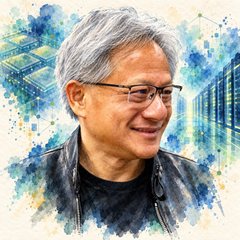
Jensen Huang
Co-founder, President and CEO, 1993-present
Co-founder and, since 1993, chief executive of NVIDIA, whose GPUs and CUDA software became the hardware base of deep learning; a leading...
-
Bill Dally Brief profile
Consultant from 2003; Chief Scientist from January 2009, later also Senior Vice President of Research, 2003-present
Parallel-computing architect who has run NVIDIA Research since 2009 and made the GPU case for deep learning inside it.
-
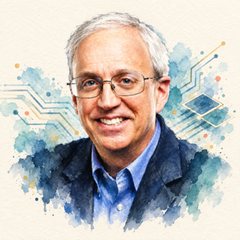
Bryan Catanzaro Brief profile
Vice President, Applied Deep Learning Research; one of the leaders of Nemotron, 2016-present
Wrote the prototype that became cuDNN, co-created Megatron and now leads NVIDIA's open Nemotron models.
-
Ian Buck Brief profile
GPU computing software manager, then general manager of accelerated computing and vice president of hyperscale and HPC, 2004-present
Created CUDA after a Stanford PhD on GPU programming; now runs NVIDIA's data-center AI products for cloud buyers.
-
Jim Fan Brief profile
Research scientist and lead of AI agents; later director and distinguished scientist, co-lead of the GEAR lab and Project GR00T, 2021-present
OpenAI's first intern, then builder of Minecraft and robot-learning agents who co-leads NVIDIA's humanoid robot models.



Formerly here
-
Bryan Catanzaro Brief profile
Research scientist, NVIDIA Research, 2011-2014
Wrote the prototype that became cuDNN, co-created Megatron and now leads NVIDIA's open Nemotron models.
-
Ian Buck Brief profile
Systems engineer, 2000-2001
Created CUDA after a Stanford PhD on GPU programming; now runs NVIDIA's data-center AI products for cloud buyers.
Sources
- NVIDIA Form 10-K for the fiscal year ended January 25, 2026 (NVIDIA, February 2026)
- NVIDIA announces financial results for second quarter fiscal 2027 (NVIDIA, August 2026)
- Testimony of Bill Dally, Chief Scientist and Head of Research, NVIDIA (US Senate Judiciary Committee, September 2023)
- NVIDIA Statement on the Biden Administration's Misguided 'AI Diffusion' Rule (NVIDIA, January 2025)
- NVIDIA to Acquire Hugging Face (Jensen Huang, NVIDIA, September 2026)
- How Jensen Huang's Nvidia is powering the AI revolution (The New Yorker, December 2023)
- "This Is Going to Be Really Big": How Nvidia's Bill Dally Shaped the AI Era (Caltech Alumni Association)
- Nvidia Will Spend 26 Billion Dollars to Build Open-Weight AI Models, Filings Show (Wired, March 2026)
- Nvidia buying AI chip startup Groq's assets for about 20 billion dollars (CNBC, December 2025)
- Nvidia backing 105 billion dollars in financing for OpenAI data center in Ohio (CNBC, August 2026)
- How the AI bubble could pop and take down the global economy, according to the BIS (The Register, June 2026)
- Jensen Huang explains why Nvidia will grow 70% next year (TechCrunch, September 2026)
- Jensen Huang says U.S. chip restrictions have cut Nvidia's China market share nearly in half (CNBC, May 2025)
- Trump greenlights Nvidia H200 AI chip sales to China if U.S. gets 25% cut (CNBC, December 2025)
- Anthropic, China chip sales like 'selling nuclear weapons to N.Korea' (Semafor, January 2026)
- Three charged in the US with smuggling AI chips into China (Al Jazeera, March 2026)
- Nvidia inks 13 billion dollar deal to buy the AI startup that was hacked by OpenAI (CNN, September 2026)
- Nvidia's Jensen Huang rejects AI extinction warnings as "doomsday narratives" (CBS News, September 2026)
- Microsoft, NVIDIA and Anthropic announce strategic partnerships (Microsoft, November 2025)
- Microsoft-backed AI startup Inflection raises 1.3 billion dollars from Nvidia and others (Reuters via Yahoo Finance, June 2023)
- NVIDIA Newsroom: NVIDIA Open Agent Safety Platform (September 28, 2026)
- Reuters via The Star, Nvidia pledges $250 million to boost UK AI safety research (October 14, 2026)