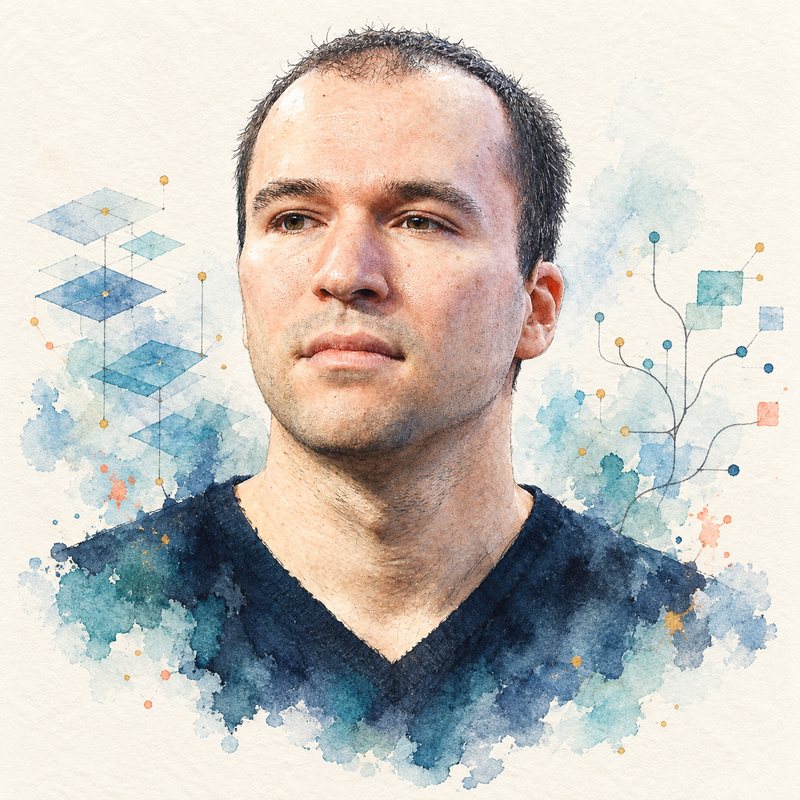
Greg Brockman
Co-founder and President, OpenAI
Co-founded OpenAI in 2015 and, as president, now runs its products, go-to-market teams and compute buildout.
Greg Brockman left MIT in 2010 to join Stripe, the payments company founded by classmate Patrick Collison, and became its first chief technology officer in 2013. After leaving Stripe in May 2015, Brockman met Sam Altman and Elon Musk and recruited the researchers who became OpenAI's founding team. The lab, announced in December 2015 with Brockman as CTO, first operated out of Brockman's living room. At the GPT-4 launch on 14 March 2023, Brockman photographed a pencil sketch of a joke website and had the model turn it into working HTML on the livestream.
Brockman also chaired the nonprofit board. On 17 November 2023 the board, as it fired Altman, also removed Brockman as chair; within hours came a resignation, then a Microsoft announcement naming Brockman co-lead of a new research group, and on 21 November a return to OpenAI alongside Altman. A sabbatical followed from August to November 2024, which Brockman called the "first time to relax since co-founding OpenAI 9 years ago."
At the Musk v. Altman trial in May 2026, Musk's lawyer read Brockman's 2017 journal entries to the jury and asked about a stake worth about 30 billion dollars. Brockman testified that the mission had "always been my primary motivation" and that Musk had wanted control of the company. The jury found Musk's claims time-barred on 18 May. That month OpenAI made Brockman's interim oversight of products permanent and merged ChatGPT and Codex into one product team; after Fidji Simo stepped down in July 2026, Brockman took formal charge of ChatGPT, go-to-market, enterprise sales and compute. On 3 September 2026 Brockman presented GPT-6 Astra and called its computer use the start of an "AGI era." Outside the company, Brockman is among the donors to Leading the Future, a super PAC that backs candidates favoring national AI rules over state-by-state laws.
Known for
Building OpenAI's founding team and engineering
Recruited the first research staff in late 2015 and, as CTO, led engineering projects including OpenAI Gym and the OpenAI Five Dota 2 system before the company's move to large language models.
OpenAI Five
Worked on the Dota 2 system trained by self-play reinforcement learning, which beat the world champion team OG in April 2019, and co-wrote the paper describing it.
Consolidating OpenAI's products
In May 2026 folded ChatGPT, Codex and the developer API into one core product team, and from July 2026 ran the company's product business and compute initiatives.
On the record
Brockman said in September 2026 that general AI had arrived in pieces rather than in one moment, and that GPT-6 Astra could reasonably be called the first model of the AGI era.
“It's not unreasonable to feel that we are now in the AGI era”
Briefing at the GPT-6 Astra launch, reported by Fortune, 3 September 2026, 2026
Career
-
2010-2015
Stripe
Engineer, then chief technology officer (from 2013)
-
2015-present
Co-founder; chief technology officer, board chairman until November 2023, and president
Sources
- Dota 2 with Large Scale Deep Reinforcement Learning (arXiv, December 2019)
- Introducing OpenAI (OpenAI, December 2015, archived)
- GPT-4 Developer Livestream (Simon Willison, March 2023)
- OpenAI co-founder Schulman leaves for Anthropic, Brockman takes extended leave (TechCrunch, August 2024)
- Brockman rebuts Musk's take on startup's history (CNBC, May 2026)
- Greg Brockman Officially Takes Control of OpenAI's Products in Latest Shake-Up (Wired, May 2026)
- OpenAI power consolidates under co-founder Greg Brockman ahead of prospective IPO (CNBC, July 2026)
- OpenAI launches GPT-6 Astra and touts its ability to use your computer (Fortune, September 2026)
- AI industry super PAC raises 125 million dollars in 2025 (CNBC, January 2026)
Brief profiles cover a person's professional record: roles, work and public statements, each from a source listed here. Full profiles, with positions across the debates, are kept for the people the site follows most closely.