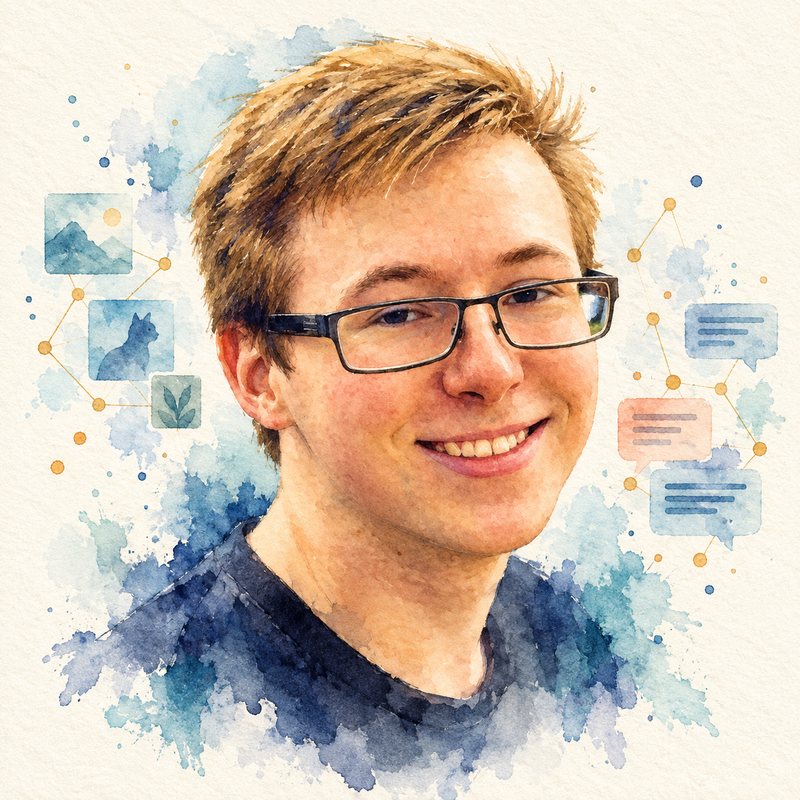
Alec Radford
Independent researcher
Lead author of the original GPT paper, CLIP and Whisper at OpenAI; since 2026 co-builds talkie, a model of 1930.
Alec Radford left Olin College in 2014 to work on Indico, a machine-learning startup begun in a dorm room with fellow students. With Luke Metz and Soumith Chintala of Facebook AI Research, Radford wrote the November 2015 DCGAN paper, whose convolutional generative adversarial networks produced plausible bedrooms and faces and showed that directions in the learned space could add or remove features such as glasses.
Radford joined OpenAI in 2016. A 2017 experiment trained a network only to predict the next character of Amazon reviews and found a single unit that tracked sentiment, a property no one had asked it to learn. In June 2018 Radford was lead author of "Improving Language Understanding by Generative Pre-Training," the first GPT: a transformer pretrained on unlabeled books and then fine-tuned for each task. Radford was also first author of GPT-2 (2019), of CLIP (2021), which learned to match images with captions from 400 million web pairs, and of Whisper (2022), a speech recognizer trained on 680,000 hours of audio, and worked on DALL-E.
Radford left OpenAI in December 2024 to do independent research, was listed as an adviser to Mira Murati's Thinking Machines Lab from March 2025, and that year was subpoenaed in the authors' copyright case against OpenAI. In April 2026 Radford, Nick Levine and David Duvenaud released talkie, a 13-billion-parameter "vintage" language model trained only on 260 billion tokens of text published before 1931. They proposed such models as contamination-free tests of forecasting and invention, for example asking whether a model that has never seen a computer can learn to write Python, and planned a GPT-3-level version next.
Known for
GPT (2018)
The paper that paired a transformer with unsupervised pretraining and task fine-tuning, the design every later GPT model and ChatGPT built on.
CLIP and Whisper
CLIP (2021) linked images and text in one model trained on web captions and became a component of DALL-E 2 and Stable Diffusion; Whisper (2022) was released as open-source speech recognition.
GPT-2 (2019)
First author of "Language Models are Unsupervised Multitask Learners," whose 1.5-billion-parameter model, trained on millions of web pages, performed tasks it was never trained for and was released in stages over misuse concerns.
Career
-
until 2016
Indico
Co-founder
-
2016-2024
Researcher
-
since 2025
Adviser (listed from March 2025)
Sources
- Radford et al., Language Models are Unsupervised Multitask Learners (OpenAI, February 2019)
- Radford, Metz and Chintala, Unsupervised Representation Learning with Deep Convolutional GANs (arXiv, November 2015)
- Radford et al., Learning to Generate Reviews and Discovering Sentiment (arXiv, April 2017)
- Radford et al., Improving Language Understanding by Generative Pre-Training (OpenAI, June 2018)
- Radford et al., Learning Transferable Visual Models From Natural Language Supervision (arXiv, February 2021)
- Radford et al., Robust Speech Recognition via Large-Scale Weak Supervision (arXiv, December 2022)
- Mira Murati's AI startup gains prominent ex-OpenAI advisers (TechCrunch, April 2025)
- Key ex-OpenAI researcher subpoenaed in AI copyright case (TechCrunch, March 2025)
- Levine, Duvenaud and Radford, Introducing talkie, a 13B vintage language model from 1930 (April 2026)
Brief profiles cover a person's professional record: roles, work and public statements, each from a source listed here. Full profiles, with positions across the debates, are kept for the people the site follows most closely.