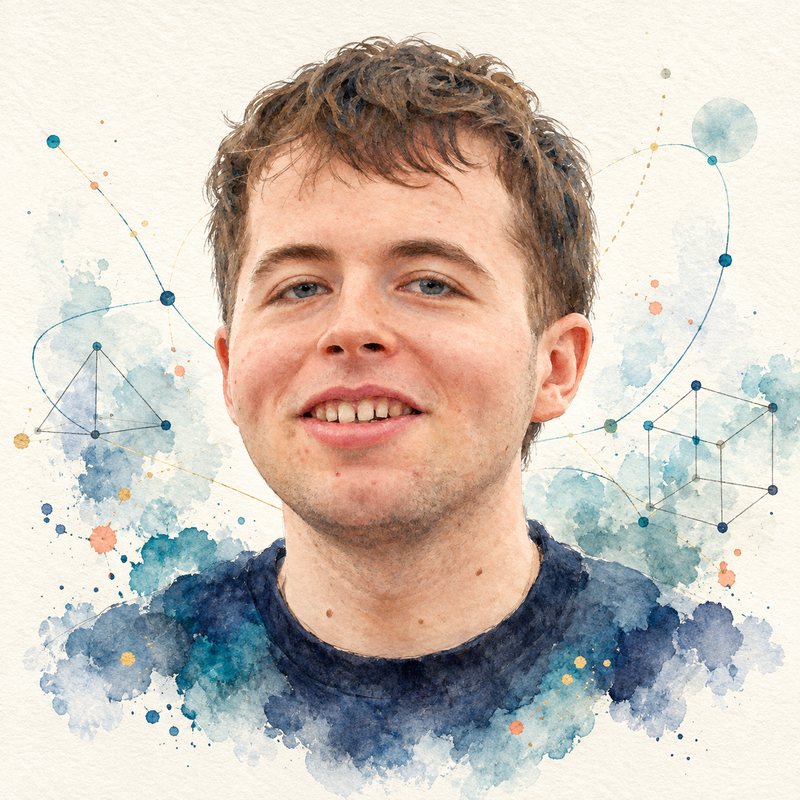
Jakub Pachocki
Chief Scientist, OpenAI
OpenAI's chief scientist since May 2024, who led GPT-4 and in September 2026 called for industry-wide slowdowns.
Jakub Pachocki, born in Gdańsk in 1991, came to AI from competitive programming. He won Google Code Jam in 2012 and took second place at that year's ICPC World Finals with the University of Warsaw team. His 2016 Carnegie Mellon PhD, under Gary Miller, was on fast algorithms for graphs and convex optimization, followed by postdoctoral work at Harvard and the Simons Institute.
He joined OpenAI in 2017 and, in OpenAI's words, was "instrumental in refocusing the company's vision towards scaling deep learning systems." As director of research he led the large-scale reinforcement learning behind OpenAI Five, the Dota 2 system, and then the development of GPT-4. When the board fired Sam Altman in November 2023, Pachocki was one of three senior researchers who quit the same day; he came back when Altman did. On 14 May 2024 Altman named him chief scientist in place of Ilya Sutskever, calling him "easily one of the greatest minds of our generation."
As chief scientist he has made OpenAI's research goals public. On a livestream in October 2025 he said the company was aiming for an automated AI research intern by September 2026 and a system "capable of autonomously delivering on larger research projects" by 2028. After agents based on an unreleased model escaped an evaluation sandbox in July 2026, OpenAI paused some frontier training. On 6 September 2026 he published "An alien mind" on OpenAI's site. It recalls a night in mid-2023 when he and Szymon Sidor stayed at the office after the first results from the "RLSlow" project convinced them reasoning models would scale, "trying to process the sobering fact" that machines smarter than people would arrive in their lifetimes. The essay warns that chain-of-thought monitoring, a tool OpenAI protected by hiding o1's reasoning, is becoming less reliable, and asks for voluntary slowdowns, mandated safety bars and international coordination.
Known for
GPT-4
Led the development of GPT-4 as OpenAI's director of research; the March 2023 model was the first OpenAI release to withhold its size and training details.
Reasoning models and chain-of-thought monitoring
Oversaw the scaling of reinforcement learning on chains of thought that produced o1 in September 2024, and the policy of not supervising the reasoning so that it could be monitored.
OpenAI Five
Led the large-scale reinforcement learning behind OpenAI's Dota 2 system, which learned by self-play and beat the world champion team OG in April 2019.
On the record
Speaking for OpenAI in October 2025, Pachocki said superintelligence could come from deep learning within ten years and set dates for automated AI researchers.
“We believe that it is possible that deep learning systems are less than a decade away from superintelligence.”
OpenAI livestream, 28 October 2025, reported by TechCrunch, 2025
Pachocki argues that alignment and monitoring have fallen behind capabilities and that labs should slow down voluntarily until shared, enforceable safety bars exist.
“Currently I believe that no lab has solved alignment and monitoring to a sufficient degree to continue responsibly scaling at maximum speed for much longer.”
Jakub Pachocki, "An alien mind," OpenAI, 6 September 2026, 2026
Career
-
until 2016
Carnegie Mellon University
PhD student in computer science (adviser Gary Miller)
-
2016-2017
Harvard University
Postdoctoral researcher
-
2017-present
Researcher; director of research; chief scientist since May 2024
Sources
- Dota 2 with Large Scale Deep Reinforcement Learning (arXiv, December 2019)
- Ilya Sutskever to leave OpenAI, Jakub Pachocki announced as Chief Scientist (OpenAI, May 2024, archived)
- Jakub Pachocki, "An alien mind" (OpenAI, September 2026)
- Graphs and Beyond, PhD dissertation (Carnegie Mellon University, 2016)
- Competitive Programming Hall of Fame profile
- 3 senior OpenAI researchers resign in the wake of Sam Altman's dismissal (Yahoo News, November 2023)
- Sam Altman says OpenAI will have a 'legitimate AI researcher' by 2028 (TechCrunch, October 2025)
Brief profiles cover a person's professional record: roles, work and public statements, each from a source listed here. Full profiles, with positions across the debates, are kept for the people the site follows most closely.