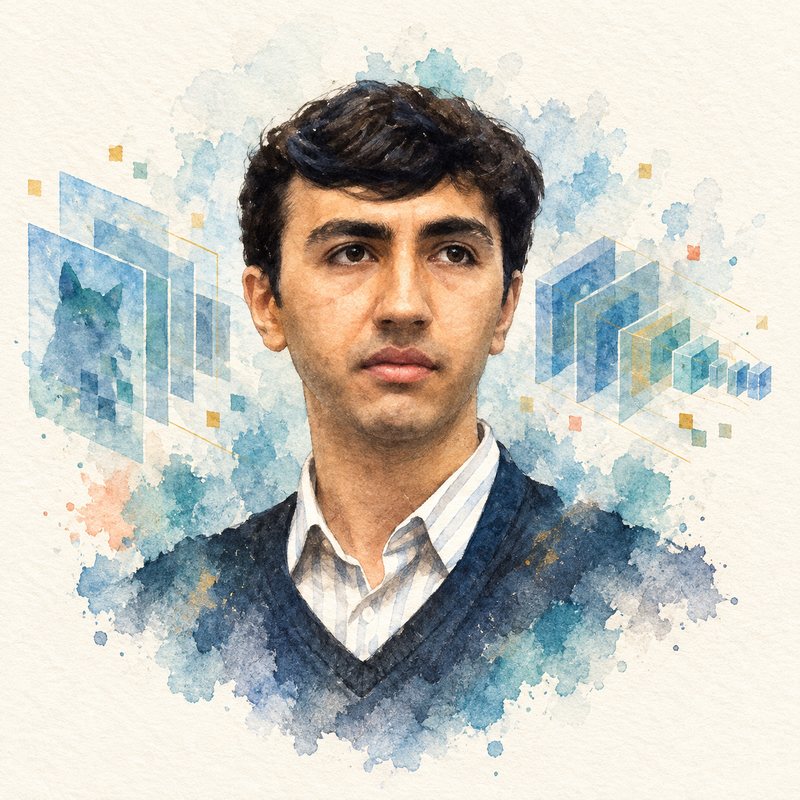
Karén Simonyan
Chief Scientist, Microsoft AI; chief scientist of the MAI Superintelligence Team
Co-created the VGG networks, worked on AlphaZero at DeepMind, co-founded Inflection; now Microsoft AI's chief scientist.
Karén Simonyan trained in computer vision at the University of Oxford's Visual Geometry Group under Andrew Zisserman. In 2014 the two published "Very Deep Convolutional Networks for Large-Scale Image Recognition," which showed that stacking many small 3-by-3 convolution filters, to depths of 16 and 19 layers, improved image recognition. The networks, known as VGG after the group, placed first in localization and second in classification at the 2014 ImageNet challenge, and their released weights became a standard starting point for other vision systems. The same year Simonyan and Zisserman proposed two-stream networks, which recognize actions in video by processing still frames and motion separately.
With Zisserman and Max Jaderberg, Simonyan co-founded Vision Factory, an Oxford spin-out aiming at "unconstrained visual recognition of objects, actions, and text." Google DeepMind hired the three in October 2014. At DeepMind Simonyan was a co-author of WaveNet (2016), which generated speech one audio sample at a time, of AlphaGo Zero and AlphaZero, which learned Go, chess and shogi from self-play alone, and of BigGAN (2018), a large image generator.
In March 2022 Simonyan co-founded Inflection AI with Mustafa Suleyman and Reid Hoffman and became chief scientist of the company, which built the Pi chatbot. When Microsoft hired most of Inflection's staff in March 2024, Satya Nadella named Simonyan chief scientist of the new Microsoft AI, reporting to Suleyman, and credited Simonyan with leading "some of the biggest AI breakthroughs over the past decade including AlphaZero." In November 2025 Simonyan became chief scientist of the MAI Superintelligence Team. The organization released its first in-house models in August 2025 and seven more in June 2026, including the reasoning model MAI-Thinking-1, which Microsoft AI said it trained from scratch without distilling other labs' models.
Known for
VGG networks
Deep convolutional networks built from small 3-by-3 filters, placed at the top of the 2014 ImageNet challenge and widely reused as feature extractors.
WaveNet and AlphaZero
Co-authored DeepMind's raw-audio speech generator and the self-play system that learned chess, shogi and Go without human game data.
Inflection and Microsoft AI models
Chief scientist at Inflection, which built the Pi chatbot, and then at Microsoft AI, which trains the MAI model family.
Career
-
until 2014
University of Oxford, Visual Geometry Group
Doctoral student and researcher with Andrew Zisserman
-
until 2014
Vision Factory
Co-founder
-
2014-2022
Research scientist
-
2022-2024
Inflection AI
Co-founder and Chief Scientist
-
2024-present
Chief Scientist, Microsoft AI; from November 2025 also chief scientist of the MAI Superintelligence Team
Sources
- Very Deep Convolutional Networks for Large-Scale Image Recognition (Simonyan and Zisserman, arXiv, September 2014)
- University of Oxford teams up with Google DeepMind on artificial intelligence (Oxford Computer Science, November 2014)
- WaveNet: A Generative Model for Raw Audio (van den Oord et al., arXiv, September 2016)
- Mastering Chess and Shogi by Self-Play with a General Reinforcement Learning Algorithm (Silver et al., arXiv, December 2017)
- Mustafa Suleyman, DeepMind and Inflection co-founder, joins Microsoft to lead Copilot (Satya Nadella, Microsoft, March 2024)
- Microsoft joins the race for superintelligence (Fortune, November 2025)
- Building a hill-climbing machine: Launching seven new MAI models (Microsoft AI, June 2026)
Brief profiles cover a person's professional record: roles, work and public statements, each from a source listed here. Full profiles, with positions across the debates, are kept for the people the site follows most closely.