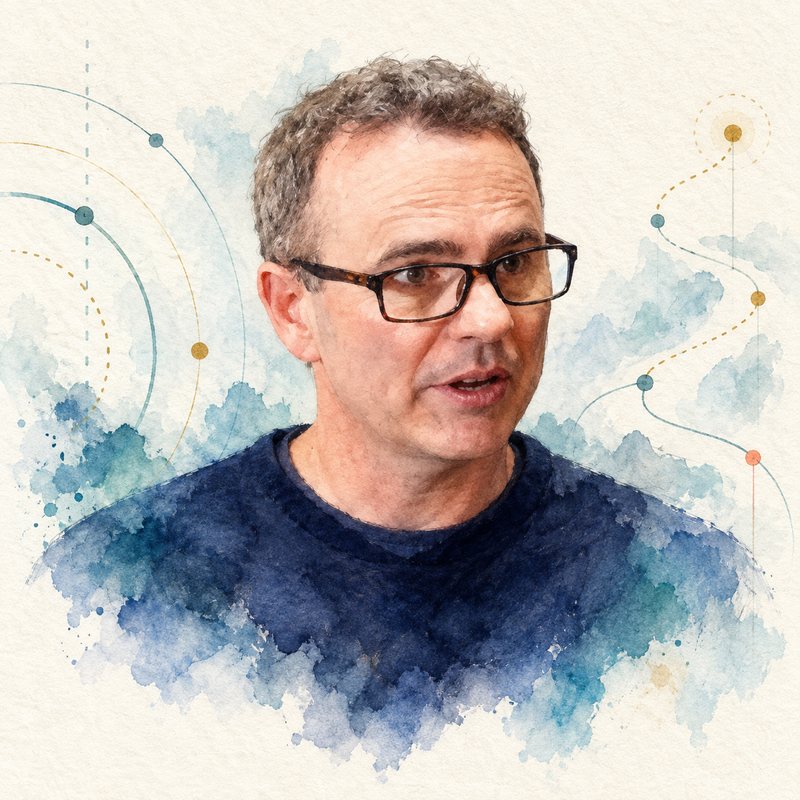
Shane Legg
Co-founder and Chief AGI Scientist, Google DeepMind
Co-founded DeepMind, proposed the name "artificial general intelligence" and has given AGI even odds by 2028 since 2011.
Shane Legg is a New Zealand-born computer scientist who co-founded DeepMind in London in 2010 with Demis Hassabis and Mustafa Suleyman, after he and Hassabis met as researchers at UCL's Gatsby Computational Neuroscience Unit. Earlier he had worked as a software engineer at Webmind, Ben Goertzel's AI start-up. In 2002, when Goertzel and Cassio Pennachin were stuck for a title for a book on human-level AI, Legg suggested "Artificial General Intelligence," the name they adopted; Goertzel later learned that Mark Gubrud had used the phrase in 1997.
Legg took a PhD at the Swiss AI lab IDSIA under Marcus Hutter, finishing in 2008 with a thesis titled Machine Super Intelligence. In 2007 he and Hutter gathered some 70 published definitions of intelligence, and in "Universal Intelligence" (December 2007) they proposed a formal measure of it, an agent's ability to achieve goals across all computable environments, weighted toward simpler ones.
At DeepMind he was Chief Scientist and started its AGI safety work, and he was an author, with OpenAI researchers, of the 2017 paper that introduced learning rewards from human preferences, the method later called RLHF. After the April 2023 merger with Google Brain he became Chief AGI Scientist; TIME reported that year that he led its AGI technical safety team. In November 2023 he co-wrote "Levels of AGI," a Google DeepMind framework for grading progress toward general intelligence.
TIME reported in August 2026 that after Hassabis handed daily control to Koray Kavukcuoglu, Legg would keep reporting to Hassabis. On 16 September 2026 Legg, Hassabis and James Manyika launched the DeepMind Institute, a Google publishing platform on AGI's effects on society, with Legg as managing editor.
Known for
Universal intelligence
A 2007 paper with Marcus Hutter that defined machine intelligence as goal-achieving ability averaged over all computable environments.
Machine Super Intelligence
His 2008 PhD thesis at IDSIA, which extended the universal intelligence measure and discussed the risks of machines that exceed human ability.
Levels of AGI
A November 2023 Google DeepMind paper, with Meredith Ringel Morris and others, that proposed grading AI systems by performance and generality, from "emerging" to "superhuman."
On the record
He has held since 2011 that there is an even chance of human-level AGI arriving by 2028.
“I think there's a 50% chance that we have AGI by 2028.”
Dwarkesh Podcast, interview with Dwarkesh Patel (October 2023), 2023
He named AI as the largest risk to humanity this century, ahead of engineered pathogens.
“It's my number 1 risk for this century, with an engineered biological pathogen coming a close second (though I know little about the latter).”
Q&A with Shane Legg on risks from AI, LessWrong (June 2011), 2011
Career
-
2009-2010
Gatsby Computational Neuroscience Unit, University College London
Research associate
-
2010-present
Co-founder; Chief Scientist, then Chief AGI Scientist
Sources
- Universal Intelligence, a Definition of Machine Intelligence (Legg and Hutter, arXiv, December 2007)
- Artificial General Intelligence, Concept, State of the Art, and Future Prospects (Ben Goertzel, draft)
- Shane Legg, TIME100 AI (TIME, September 2023)
- Shane Legg on 2028 AGI and superhuman alignment (Dwarkesh Podcast, October 2023)
- Deep reinforcement learning from human preferences (Christiano, Leike, Brown, Martic, Legg and Amodei, arXiv, June 2017)
- Inside Google DeepMind's reshuffle (TIME, August 2026)
- Introducing the DeepMind Institute (DeepMind Institute, September 2026)
- Google DeepMind launches institute to widen the AGI debate (TechCrunch, September 2026)
Brief profiles cover a person's professional record: roles, work and public statements, each from a source listed here. Full profiles, with positions across the debates, are kept for the people the site follows most closely.