"But we haven't learned how to stop imagining the mind behind it."
Computational linguist at the University of Washington who co-wrote the octopus paper and "On the Dangers of Stochastic Parrots," coined the phrase "stochastic parrot," and co-wrote The AI Con with Alex Hanna.
Learning to talk to everyone
Bender was born in 1973, the daughter of the writer Sheila Bender, with whom she later co-wrote a two-part essay, "More than your English teacher ever told you," for her mother's online magazine, Writing It Real. In high school, she told New York magazine, she declared that she wanted to learn to talk to everyone on earth. She took her first linguistics class at the University of California, Berkeley in the spring of 1992, her freshman year, and in 1993 she took Intro to Morphology and Intro to Programming in the same term. After her teaching assistant presented a grammatical analysis of a Bantu language, she wrote a program to implement it, longhand on paper, at a bar near campus while her boyfriend, the computer scientist Vijay Menon, watched a basketball game. It ran when she typed it in. The TA shrugged. "If I had shown that to somebody who knew what computational linguistics was," she said later, "they could have said, 'Hey, this is a thing.'"
She spent 1993 to 1994 at Tohoku University in Sendai on a Japanese Ministry of Education fellowship and graduated from Berkeley in 1995 with the University Medal, given to one graduating senior each year. Her CV lists advanced Japanese and French, intermediate Mandarin and American Sign Language, and beginning Malayalam and German. At Stanford, on a National Science Foundation fellowship, she joined the Head-Driven Phrase Structure Grammar (HPSG) and LinGO projects at the Center for the Study of Language and Information (CSLI). Her dissertation, completed in October 2000 under Thomas Wasow and Penelope Eckert with John Rickford, Ivan Sag and Arnold Zwicky on the committee, asked how a formal competence grammar could accommodate copula absence in African American English, a variable whose use is shaped by social meaning rather than by categorical rules.
Grammar engineering
For three years after the PhD she kept a foot in academia and one in industry. She taught at Berkeley and Stanford, co-wrote the 2003 second edition of Sag and Wasow's textbook Syntactic Theory: A Formal Introduction, and worked in 2001 and 2002 as a grammar engineer for Japanese at a start-up, YY Technologies. With Melanie Siegel she described the Japanese HPSG grammar Jacy in 2002, and the two documented it with Francis Bond in a 2016 book.
Her best-known technical project grew out of that work. The hand-built precision grammars of English, German and Japanese had each taken between 5 and 15 person-years and ran to 35,000 to 70,000 lines of code, and their accumulated analyses were, as she and her co-authors put it, "only available through painstaking inspection of the grammars and/or consultation with their authors." In 2002, with Dan Flickinger and Stephan Oepen, she proposed the Grammar Matrix, a starter kit that distils what the existing grammars share into a reusable core, so that a grammar for a new language could start from a cross-linguistically tested base and produce the same kind of semantic representations. An NSF CAREER grant of $474,229 in 2007 funded the work on the Matrix as "computational linguistic typology." With Fei Xia she then started the AGGREGATION project, which tries to generate grammars automatically from the interlinear glossed text that field linguists already produce, for the benefit of language documentation. Her students have extended the Matrix with libraries for evidentiality, information structure and noun incorporation, and her student Joshua Crowgey wrote his 2019 dissertation on grammar engineering for Lushootseed, a Salish language of Puget Sound. A 2022 retrospective in the Journal of Language Modelling, "20 years of the Grammar Matrix," described how it had been used to test hypotheses about increasingly complex interactions between phenomena across languages.
Building a program, naming the language
The University of Washington hired her in 2003, and in 2005 she launched its professional master's program in computational linguistics (CLMS), offered both in Seattle and online, which she has directed ever since while also running the department's Computational Linguistics Laboratory. At conferences of the Association for Computational Linguistics she noticed that many people building language technology knew little linguistics, and she began giving tutorials under titles such as "100 Things You Always Wanted to Know About Linguistics But Were Afraid to Ask." She later wrote two short books for practitioners, Linguistic Fundamentals for Natural Language Processing (2013) and a second volume on semantics and pragmatics with Alex Lascarides (2019). New York magazine reported that when an Amazon recruiter approached her and she declined, he asked, "You're not even going to ask how much?"
A theme ran through all of it: most of the field worked on English and treated English as the default. In a 2011 paper she wrote, "Do state the name of the language that is being studied, even if it's English." In November 2018, frustrated again, she tweeted that "Natural Language" is not a synonym for "English." In the spring of 2019 Nathan Schneider, Yuval Pinter, Robert Munro and Andrew Caines independently began calling the practice the "Bender Rule," and posters at NAACL and ACL that summer cited it by name. In a September 2019 essay for The Gradient she said she was happy to lend her name to a principle that "seems obvious and trivial," because the field would not broaden beyond a handful of languages until it stopped pretending that work on English alone was not language-specific. The same concern produced Data Statements for Natural Language Processing (2018), written with Batya Friedman, which asks dataset builders to record which speakers, varieties and annotators a corpus represents. She began teaching a seminar on ethics in language technology in 2017 and co-chaired the ethics review committee for NAACL 2021.
The octopus and the parrots
By 2019 language models such as BERT and GPT-2 were topping benchmarks that were supposed to require understanding, and papers and press coverage said the models "understood" language. Bender and Alexander Koller of Saarland University answered at ACL in July 2020 with a position paper, "Climbing towards NLU." Its argument turned on a thought experiment. Two people stranded on separate islands talk by telegraph; a hyper-intelligent deep-sea octopus taps the cable, learns to predict their messages, and eventually impersonates one of them. It gets away with small talk, but when the other islander is chased by a bear and asks how to build a weapon from sticks, the octopus has nothing to offer, because it has only ever seen the form of the words. Bender first told the story with a dolphin; Koller argued for an octopus, whose world is further from ours and which is, she said later, "just inherently funnier." A footnote records that when they gave the bear prompt to GPT-2, it replied, "You're not going to get away with this!" The paper won ACL 2020's Best Theme Paper award.
That autumn Bender and Timnit Gebru, then co-lead of Google's Ethical AI team, wrote "On the Dangers of Stochastic Parrots: Can Language Models Be Too Big?" with Angelina McMillan-Major, Bender's PhD student, and Margaret Mitchell, a former student of hers who co-led the Google team. Bender came up with the title phrase while drafting. In early October 2020, she has written, a Google search for "stochastic parrot" returned zero hits. She later learned of a July 2020 blog post by Regina Rini that mentioned a "statistical parrot," and recalled that Stuart Russell had emailed her and Koller in September 2020 praising the octopus paper as "a breath of sanity" amid the field's enthusiasm for "randomized parrots"; she offered him a footnote and he declined. When Google told its employees to withdraw from the paper, Gebru set conditions for staying and left the company in December 2020, in circumstances she describes as a firing and Google as a resignation. MIT Technology Review, which obtained the draft from Bender, summarized it on 4 December; she asked the magazine not to name the Google co-authors "for fear of repercussions," and noted that as a tenured professor she was protected by academic freedom. Mitchell was fired in February 2021. The paper appeared at the ACM FAccT conference in March 2021 with Mitchell listed as "Shmargaret Shmitchell" and an acknowledgment that some of its seven authors had been required by their employer to remove their names. Four days after ChatGPT's release, on 4 December 2022, Sam Altman posted, "i am a stochastic parrot, and so r u."
Mystery AI Hype Theater 3000
Bender told New York magazine that in 2016, with Donald Trump running for president and Black Lives Matter protests in the streets, she decided to take some small political action every day, and began reading and amplifying Black women who were criticizing AI, including Joy Buolamwini and Meredith Broussard. She also started challenging the term "artificial intelligence" itself, and remains fond of an alternative an Italian former member of parliament proposed, "Systematic Approaches to Learning Algorithms and Machine Inferences," or SALAMI. In July 2022, on a panel at a large computational linguistics conference, she debated the Stanford computational linguist Christopher Manning over whether meaning requires reference to the world; he argued for a broader, distributional notion of meaning, and she told the audience, "I feel like there's too much effort trying to create autonomous machines, rather than trying to create machines that are useful tools for humans."
In August 2022 she and Alex Hanna, then newly director of research at the Distributed AI Research Institute (DAIR), tried a one-off live stream reacting to a piece of AI hype, with a title borrowed from the television show Mystery Science Theater 3000. They surprised themselves by making it a series, and in the spring of 2023 turned the streams into the podcast Mystery AI Hype Theater 3000, produced with Christie Taylor and opened every episode as "a podcast where we seek catharsis in this age of AI hype." They call the method "ridicule as praxis." When the Future of Life Institute called in March 2023 for a six-month pause on training systems more powerful than GPT-4, Bender, Gebru and McMillan-Major replied on 31 March that its "hypothetical risks are the focus of a dangerous ideology called longtermism that ignores the actual harms resulting from the deployment of AI systems today," and that "Accountability properly lies not with the artifacts but with their builders." TIME put her on its first TIME100 AI list that September, and on 18 October 2023 she testified at a joint hearing of two subcommittees of the House Committee on Science, Space, and Technology on managing the risks of AI. Her CV lists consultations that year with the White House Office of Science and Technology Policy, the staff of several senators and representatives, and the Federal Trade Commission's chief technologist.
The AI Con
Bender was elected vice president-elect of the Association for Computational Linguistics in November 2021 and served as its president in 2024; her presidential address at ACL 2024 in Bangkok on 14 August was titled "ACL Is Not an AI Conference." In March 2025 she debated Sébastien Bubeck of OpenAI, lead author of the "Sparks of Artificial General Intelligence" paper, at the Computer History Museum in Mountain View on the question "Do LLMs really understand?" Bubeck said "understanding is in the eye of the beholder"; Bender said that the claim that they understand was extraordinary, needed extraordinary evidence, and could not be checked while the data behind it stayed hidden.
The AI Con: How to Fight Big Tech's Hype and Create the Future We Want, written with Hanna, was published by Harper on 13 May 2025 and by the Bodley Head in Britain on 22 May, with Spanish and Italian translations following in 2026. It proposes replacing "AI" with the specific automation being sold, calling chatbots "conversation simulators," and meeting unfit deployments with "strategic refusal." Its argument about work, as Hanna put it in interviews, is that AI "is not going to take your job, but it will likely make your job shittier." In June 2025 they wrote in Tech Policy Press that "AGI" is a vague signifier and "conveniently also a means to avoid accountability." She took the argument to the European Parliament's special committee on the European Democracy Shield in July 2025 and to UNESCO's Digital Learning Week in September 2025, where her lecture was titled "We do not have to accept AI (much less AGI) as inevitable in education." On the paper's fifth anniversary, in May 2026, she published "Stochastic Parrots: Frequently Unasked Questions," and told IEEE Spectrum in June 2026 that the paper's biggest omission was exploitative labor, both the conditions of data workers and "the massive theft of people's creative and intellectual output." Her CV, updated in July 2026, lists her as Wyckoff Endowed Professor for 2024 to 2027 and records appearances in two 2026 documentaries, Valerie Veatch's Ghost in the Machine and a Focus Features film, The AI Doc.
Timeline
-
PhD, Stanford
Dissertation on copula absence in African American English, advised by Thomas Wasow and Penelope Eckert.
-
"Natural Language" is not a synonym for "English"
The tweet restated a rule from her 2011 paper and led others to name it the Bender Rule the following spring.
-
The
Explained in The Gradient why naming the language studied, even English, matters for the field.
-
The octopus paper at ACL
"Climbing towards NLU," with Alexander Koller, argued that meaning cannot be learned from form alone and won the Best Theme Paper award.
-
No prior hits for "stochastic parrot"
Having come up with the phrase while drafting the paper with Timnit Gebru, she searched Google in early October and found no earlier use.
-
MIT Technology Review publishes the paper's contents
Two days after Gebru's exit from Google, the magazine summarized the draft, which it obtained from Bender.
-
Stochastic Parrots published at FAccT
Appeared with Margaret Mitchell listed as "Shmargaret Shmitchell" after Google employees were told to remove their names.
-
Elected to lead the ACL
Chosen as vice president-elect, on track to become president of the Association for Computational Linguistics in 2024.
-
Guardian essay on LaMDA
After a Google engineer claimed the company's chatbot was sentient, she wrote that human-like programs "abuse our empathy."
-
Debates Christopher Manning at NAACL
A conference panel on whether language models can learn meaning without reference to the world.
-
First Mystery AI Hype Theater 3000 stream
A one-off live stream with Alex Hanna reacting to AI hype, which became a series and, in 2023, a podcast.
-
"You Are Not a Parrot"
Elizabeth Weil's New York magazine profile brought the octopus paper to a general audience.
-
Response to the pause letter
With Gebru and McMillan-Major, argued the Future of Life Institute letter served longtermism and ignored present harms.
-
TIME100 AI
Named to TIME's first list of the most influential people in artificial intelligence.
-
House Science Committee testimony
Witness at a joint subcommittee hearing on foundations for managing AI risk.
-
"ACL Is Not an AI Conference"
Her presidential address to the Association for Computational Linguistics in Bangkok.
-
The Great Chatbot Debate
Argued against OpenAI's Sébastien Bubeck at the Computer History Museum that LLMs do not understand.
-
The AI Con published
Harper published the book she wrote with Alex Hanna.
-
"The Myth of AGI"
With Hanna in Tech Policy Press, described AGI as a vague term that helps companies avoid accountability.
-
Stochastic Parrots FAQ
On the paper's fifth anniversary, answered the most common misreadings of the phrase.
-
IEEE Spectrum interview
Said the paper's largest omission was exploitative labor practices.
Key contributions
The LinGO Grammar Matrix
Precision grammars that map sentences to detailed semantic representations were expensive to build, and each one encoded years of undocumented decisions. The Grammar Matrix, introduced by Bender, Dan Flickinger and Stephan Oepen in 2002 and developed in the DELPH-IN consortium, packages what those grammars share into an open-source starter kit and a web questionnaire: a linguist describes a language's word order, case, agreement and other properties, and the system produces a working HPSG grammar compatible with DELPH-IN's parsers and generators. Two decades of student projects have extended it to phenomena such as evidentiality, noun incorporation and information structure, which makes it a running test of claims about how grammatical systems vary across languages.
Training computational linguists at UW
The Professional Master's Program in Computational Linguistics, which Bender launched in 2005 and still directs, teaches students who will build language technology how language works, in Seattle and online. Its master's theses, which she lists by name, range from a finite-state morphological analyzer for Central Alaskan Yup'ik to a conversation analysis of users talking to a language model. In her course LING 567, students write grammars for lesser-known languages.
The form and meaning argument
"Climbing towards NLU" (2020, with Alexander Koller) defined meaning as the relation between linguistic form and something outside language, such as communicative intent or the world, and argued that a system trained only on strings has no access to that relation. The octopus thought experiment made the claim vivid, and a companion example about training a model on all the Java code on GitHub made it formal. The paper does not say language models are useless; it says they learn "some reflection of meaning into the linguistic form which is very useful in applications," and asks for precise language about what that is.
On the Dangers of Stochastic Parrots
The 2021 paper with Timnit Gebru, Angelina McMillan-Major and Margaret Mitchell reviewed the risks of scaling language models: training costs borne by communities least likely to benefit, web-scraped data too large to document and skewed toward dominant views, research effort diverted from understanding, and synthetic text fluent enough to be mistaken for meaning. It recommended documenting datasets, weighing environmental costs before training, and treating the mimicry of human behavior as "a bright line in ethical AI development." The dispute over its publication ended with both of Google's Ethical AI co-leads leaving the company, and its title phrase entered general use.
Data statements
Data Statements for Natural Language Processing, written with Batya Friedman and published in Transactions of the ACL in 2018, asks the builders of language datasets to document curation rationale, language variety, speaker and annotator demographics, speech situation and text characteristics, so that users can tell whose language a system was trained on and where it will fail. It appeared in the same year as Datasheets for Datasets and Model Cards, and with them set the documentation norms the Stochastic Parrots paper later asked large-model builders to meet. A 2024 paper with McMillan-Major and Friedman traced how the idea moved into community practice.
The Bender Rule
Her 2011 advice to "state the name of the language that is being studied, even if it's English," was named for her by other researchers in 2019, and posters at NAACL and ACL that year cited it by name. The point is methodological. English is one language with its own idiosyncrasies, which she likens to one window's particular pattern of raindrops, so a technique tested only on English cannot be assumed to be language-independent, and papers that leave the language unnamed hide the assumption.
A public vocabulary against AI hype
Through Mystery AI Hype Theater 3000 and The AI Con, Bender and Alex Hanna built a set of substitutions meant to make claims testable: "automation" for "artificial intelligence," "synthetic text extruding machine" for large language model output, "conversation simulator" for chatbot, and a list of questions to ask of any system (what is being automated, whose labor built it, how it was evaluated, who is accountable when it fails). Her 2024 FAccT paper with Nanna Inie and others tested the premise, measuring how anthropomorphic descriptions of technical systems change people's trust in them.
How Emily thinks
The ideas that organize this person's work and public arguments.
Form is not meaning
Bender's core claim is a linguist's distinction. Linguistic form is the observable part of language (the spellings, sounds or signs and their arrangements); meaning is what speakers use form to convey, which ties it to intentions and to the world. A system trained to predict strings sees only form, so however well it predicts, it cannot recover the mapping to what the strings are about. The octopus that eavesdrops on a telegraph cable can mimic small talk but cannot help an islander fend off a bear. The strongest objection comes from distributional semantics, the view Christopher Manning defended against her in 2022 that "the meaning of a word is simply a description of the contexts in which it appears," and from researchers such as Geoffrey Hinton and Sébastien Bubeck who judge understanding by what systems can do. Bender's reply is that fluent behavior is exactly what a reader would expect from a good model of form, so it cannot settle the question. She has conceded one point, that models trained on images and text together may meet her definition "in an extremely thin way."
Stochastic parrots
The 2021 paper described a language model as "a system for haphazardly stitching together sequences of linguistic forms it has observed in its vast training data, according to probabilistic information about how they combine, but without any reference to meaning." Bender says the phrase draws on the verb "to parrot," meaning to repeat without understanding, and on "stochastic" for the random, probability-weighted remixing that means the output is rarely a copy. She insists it is a description, not a hypothesis that a better model could refute, and not an insult, since the systems cannot take offense. It became the name for one side of the argument over chatbots; Sam Altman's reply in December 2022, "i am a stochastic parrot, and so r u," turned it around to question human understanding instead, a move Bender calls devaluing people "to match what the language model can do." Her 2026 FAQ adds a phrase for what the systems do when prompted, "synthetic text extruding machines," and a warning that critics who treat "stochastic parrots" as a full account of AI's political economy are asking a metaphor to do a sociologist's work.
Name the language
The Bender Rule, "always name the language you're working on," sounds like etiquette but carries an argument about evidence. Surveys she cites found that between 55 and 90 percent of papers at ACL and EACL conferences from 2004 to 2016 studied English, and reviewers often mistook the state of the art for English as the state of the art. If a paper does not say its data are English, a result that depends on English's particular properties passes as a general one. The rule extends into data statements, which ask for the variety, speakers and annotators behind a dataset, and into her critique of large language models trained on web text that over-represents whoever writes most online. She has granted that the principle "seems obvious and trivial," and her answer in 2019 was that the field was still not following it.
Resisting hype by renaming it
Bender treats vocabulary as the first place hype does its work. "Artificial intelligence," "hallucination," "reasoning" and "understanding" all imply a mind, and she and Alex Hanna replace them with descriptions of the automation involved, and they ask of any system what is being automated, who benefits, whose labor built it, how it was evaluated and who is accountable when it fails. Mystery AI Hype Theater 3000 adds humor to the method ("ridicule as praxis"), and The AI Con adds "strategic refusal," declining to use or feed systems that fail those questions. She groups AI "boosters" and "doomers" together, since both start from the premise that powerful AI is inevitable and imminent. Bender and Hanna say the approach gives policymakers and the public a way to evaluate claims; critics, including a 2025 LLRX review of the book, say its polemical tone leaves little room for the benefits that users report. In 2024 she and colleagues tested the premise in a FAccT paper that measured how anthropomorphic descriptions of systems change people's trust in them.
Perspectives
Where Emily stands on the debates shaping the field. Marked lines show how a view has moved.
Language models and understanding #
A language model trained only on text learns patterns of linguistic form, not meaning, because meaning is the relation between form and something outside language; when its output makes sense, the sense is supplied by the reader.
Shaped by BERT, 2018 GPT-3, 2020 On the Dangers of Stochastic Parrots, 2021
"a system trained only on form has a priori no way to learn meaning"
In May 2026 she allowed that image and text models might meet the paper's definition of understanding "in an extremely thin way," while holding that the illusion of meaning in their text is unchanged.
AI hype #
She treats "artificial intelligence" as a marketing term that lumps together unrelated technologies and makes each sound more capable and less accountable than it is, and asks people to name the specific automation instead.
"The phrase "artificial intelligence" both groups together disparate technologies and oversells what each one of them can do."
She began publicly challenging the term in 2016; by 2025 she said she would never call anything "good about AI" because "I don't think AI is a thing."
AGI and longtermism #
Artificial general intelligence has no agreed definition and names no imminent technology; talk of it, whether utopian or apocalyptic, serves longtermist ideology and helps companies avoid accountability for present harms.
"AGI is a term that famously lacks a precise meaning, and certainly does not refer to any particular imminent technology."
In 2023 she described the extinction-risk movement as a "clown car" competing for policymakers' attention; by 2025 she and Hanna were arguing that AGI promises were being used to justify blocking state AI regulation.
Regulation #
Regulation should target the people and companies that build and deploy automated systems, requiring them to disclose training data and model architectures, label synthetic media, and answer for their products' outputs, rather than chase hypothetical future systems.
"What we need is regulation that enforces transparency."
She has since taken the argument to congressional hearings, the FTC and the European Parliament; by 2025 she and Hanna were also calling for data-protection rules on the model of the EU's GDPR and pointing to union contracts that limit workplace automation.
Data and labor #
Large models depend on taking other people's writing and art without consent and on poorly paid data workers who label and filter the output.
Shaped by On the Dangers of Stochastic Parrots, 2021
"There was one really big form of harm that we did not cover in the paper, and that has to do with exploitative labor practices."
The 2021 paper focused on undocumented training data; she now says labor exploitation and "the massive theft of people's creative and intellectual output" should have been in it.
Synthetic text and the information ecosystem #
Synthetic text released into the web is a form of pollution that makes trustworthy information harder to find and trust; companies that produce it should be held accountable, starting with machine-readable watermarks.
"When Dow or 3M or Exxon or whomever spills chemicals into the physical ecosystem, we work to hold them accountable. We should build similar protections for our information ecosystem."
English as the default language #
Work on English alone is as language-specific as work on any other language, and treating English as the unnamed default hides how poorly techniques may transfer to the world's other 7,000 languages.
"Do state the name of the language that is being studied, even if it's English."
Critics and counterpoints
The strongest cases against Emily's positions, and where each argument stands.
Do large language models understand?
No. Understanding means connecting language to something outside it, and a model trained on form alone has no way to learn that connection; fluent output shows how well it models form and how readily readers supply meaning.
Geoffrey Hinton, asked by Eric Topol in 2024 where he stood on "the stochastic parrot versus a level of understanding," said, "I fall on the sensible side. They really do understand," and told 60 Minutes in October 2023 that the models can understand. Sébastien Bubeck argued against Bender in March 2025 that "understanding is in the eye of the beholder," to be judged by probing a system rather than from its training objective, and pointed to models moving from high-school mathematics to problems no human can solve alone. Christopher Manning holds that meaning can be defined distributionally, by the contexts in which words appear, so a model of text can capture a real kind of meaning.
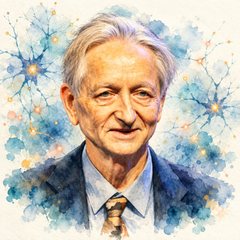 Geoffrey Hinton
Where it stands. There is no agreed test. Bender now grants that image and text models may understand "in an extremely thin way"; Hinton has gone further, saying in 2026 that multimodal systems have subjective experiences. Source
Existential risk versus present harms
Extinction scenarios belong to a longtermist ideology and compete for the same scarce policymaker attention as documented harms such as false arrests from face recognition, denied benefits and synthetic sexual imagery, which are "existentially serious" to the people affected.
Geoffrey Hinton told CNN in May 2023 that the concerns of Gebru and her colleagues were not "as existentially serious as the idea of these things getting more intelligent than us and taking over." Yoshua Bengio, who signed the pause letter Bender co-rebutted, argues that democracies can address long-term and short-term harms together, as they do with climate change, and that even a low-probability catastrophe of that size deserves attention.
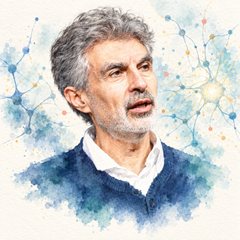 Yoshua Bengio
Where it stands. Bender rejects the "schism" framing, arguing in July 2023 that only the present-harms side can properly be called a body of scholarship and that pairing the two helps the other side compete for policymakers' attention. Source
Is AGI a meaningful goal?
AGI is a vague, shifting term that names no particular technology; promising it justifies diverting public money and blocking regulation, and resembles a belief in a benevolent or vengeful "robot god."
The labs give working definitions. OpenAI's charter defines AGI as "highly autonomous systems that outperform humans at most economically valuable work," and Demis Hassabis has suggested that autonomous AI scientists could cure cancer and eliminate disease within five to ten years. Sam Altman has proposed that once AGI is built its benefits be shared as "universal basic compute." Bubeck told the Computer History Museum audience in 2025 that reaching AGI is plausible, pointing to the pace of progress on benchmarks.
 Demis Hassabis
 Sam Altman
Where it stands. The term still has no shared definition. Part of the disagreement is now over whether benchmarks such as ARC can measure general intelligence at all, which Bender denies on the grounds that a benchmark only ever samples a "whole wide world." Source
Build carefully, or refuse?
Much of the effort goes into making autonomous machines that mimic people rather than useful tools, and refusal is a legitimate response, especially in strained systems such as education, health care and the courts, where synthetic text can be "worse than nothing."
Christopher Manning told New York magazine that slowing development is neither desirable nor possible, because "there are other players who are more out there who feel less morally bound," so responsible researchers should keep building. Reviewers of The AI Con, including LLRX in 2025, argued that the book gives little attention to benefits that users and researchers report.
Where it stands. The argument continues in her own university; in June 2026 UW revised a proposed AI minor after criticism on ethical grounds, and she is quoted in the student press on AI's use on campus. Source
Notable works
| Title | Type | Year | Why it matters |
|---|---|---|---|
| Syntactic Theory: A Formal Introduction (second edition) | book | 2003 | Co-author, with Ivan Sag and Thomas Wasow, of the second edition of the HPSG textbook and its instructor's manual. |
| The Grammar Matrix: An Open-Source Starter-Kit for the Rapid Development of Cross-linguistically Consistent Broad-Coverage Precision Grammars | paper | 2002 | With Dan Flickinger and Stephan Oepen at a COLING 2002 workshop in Taipei; the start of her main engineering project. |
| Linguistic Fundamentals for Natural Language Processing: 100 Essentials from Morphology and Syntax | book | 2013 | Grew out of her tutorials for NLP researchers; a second volume on semantics and pragmatics with Alex Lascarides followed in 2019. |
| Data Statements for Natural Language Processing: Toward Mitigating System Bias and Enabling Better Science | paper | 2018 | With Batya Friedman in Transactions of the ACL; a documentation standard for language datasets. |
| The #BenderRule: On Naming the Languages We Study and Why It Matters | essay | 2019 | The Gradient, 14 September 2019; the history of the rule and the case for data statements. |
| Climbing towards NLU: On Meaning, Form, and Understanding in the Age of Data | paper | 2020 | With Alexander Koller at ACL 2020; the octopus paper, Best Theme Paper. |
| On the Dangers of Stochastic Parrots: Can Language Models Be Too Big? | paper | 2021 | With Timnit Gebru, Angelina McMillan-Major and Margaret Mitchell at FAccT 2021. |
| Human-like programs abuse our empathy - even Google engineers aren't immune | essay | 2022 | The Guardian, 14 June 2022, written after a Google engineer declared the LaMDA chatbot sentient. |
| Mystery AI Hype Theater 3000 | podcast | 2022 | Co-hosted with Alex Hanna since August 2022, first as live streams and from 2023 as a podcast. |
| Statement from the listed authors of Stochastic Parrots on the "AI pause" letter | essay | 2023 | With Timnit Gebru and Angelina McMillan-Major, 31 March 2023. |
| The AI Con: How to Fight Big Tech's Hype and Create the Future We Want | book | 2025 | With Alex Hanna; Harper, 13 May 2025, and the Bodley Head in the UK. |
| Stochastic Parrots: Frequently Unasked Questions | essay | 2026 | Her fifth-anniversary account of what the phrase does and does not claim, and where it came from. |
Where to start
A short path into Emily's work, in order.
-
1
You Are Not a Parrot (New York magazine)essay
Elizabeth Weil's March 2023 profile covers her life, the octopus, the parrots and her disagreement with Christopher Manning. About 40 minutes.
-
2
Climbing towards NLUpaper
Read section 4, the octopus test, and the GPT-2 bear appendix first; the argument about form and meaning takes about an hour in full.
-
3
On the Dangers of Stochastic Parrotspaper
The section on "coherence in the eye of the beholder" is where the phrase is defined. About an hour.
-
4
Stochastic Parrots: Frequently Unasked Questionsessay
Her own 2026 answers to the common misreadings, plus the story of the coinage. Twenty minutes.
-
5
Ninety minutes with Sébastien Bubeck at the Computer History Museum in March 2025, the clearest live version of both sides.
-
6
The AI Conbook
The full case with Alex Hanna, for general readers, with endnotes at the back. A weekend.
Misconceptions
Bender says AI is a stochastic parrot.
She rejects "AI" as a description of any technology; the phrase refers only to language models used to produce synthetic text, and she has said chess engines, AlphaFold and machine translation systems were never its subject. Source
Newer models have disproved the stochastic parrots hypothesis.
She describes the phrase as a metaphor, not an empirical hypothesis, so it cannot be disproved; the closest thing to a testable argument is the form and meaning argument in the 2020 octopus paper. Source
Bender was one of the Google researchers who lost their jobs over the paper.
She has been a professor at the University of Washington since 2003 and never worked for Google. Her co-authors Timnit Gebru and Margaret Mitchell left Google; Bender was the one who shared the draft with MIT Technology Review. Source
Awards
- University Medal, University of California, Berkeley Awarded to one graduating senior each year.
- NSF CAREER Award $474,229 over five years for the Grammar Matrix as computational linguistic typology.
- ACL 2020 Best Theme Paper For "Climbing towards NLU," with Alexander Koller.
- Fellow, American Association for the Advancement of Science
- TIME100 AI Named to TIME's first list of the 100 most influential people in AI.
Quotes
"I mean, what's tenure for, after all?"
"Synthetic media creating non-consensual porn is existentially serious to its targets."
"We are working at a scale where the people building the things can't actually get their arms around the data"
"'Artificial intelligence' is an inherently anthropomorphizing term. It sells the tech as more than it is"
"You're never going to hear me say there are things that are good about AI, and that's not that I disagree with all of this automation. It's just that I don't think AI is a thing."
"when the text that comes out of one of these systems makes sense, it's because we are making sense of it."
"With the octopus thought experiment, I initially had told the story in terms of a dolphin, because dolphins clearly are intelligent animals."
Related leaders
-
Timnit Gebru
Co-author of "On the Dangers of Stochastic Parrots" (2021) and of the March 2023 statement answering the pause letter; Bender's podcast is produced with Gebru's DAIR Institute.
-
Geoffrey Hinton
Holds the opposite position on whether language models understand ("They really do understand"); Bender's 2023 essay on the "schism" criticized his remark that Gebru's concerns were not "as existentially serious" as AI takeover.
-
Sam Altman
Posted "i am a stochastic parrot, and so r u" four days after ChatGPT's release; Bender and Hanna's "The Myth of AGI" takes his "universal basic compute" proposal as an example of AGI mysticism.
-
Yoshua Bengio
Signed the March 2023 pause letter that Bender, Gebru and McMillan-Major answered as longtermist fearmongering; his 2024 essay argues for addressing catastrophic and present harms together.
-
Demis Hassabis
Bender and Hanna's essay "The Myth of AGI" (2025) cites his suggestion that autonomous AI scientists could cure cancer and eliminate disease within five to ten years as an example of what AGI promises are used to justify.
-
Ilya Sutskever
Bender and Hanna cite his "Feel the AGI!" office chants at OpenAI as the mysticism behind the term they reject.
-
Mustafa Suleyman
Shares her view that chatbots are not conscious and should not be built to seem like people, which his 2025 "Seemingly Conscious AI" essay argues, but leads Microsoft AI's "humanist superintelligence" effort, the kind of framing her 2025 essay with Hanna, "The Myth of AGI," rejects.


Details and links
Organizations
- University of Washington Professor of Linguistics; faculty director, Professional MS in Computational Linguistics; director, Computational Linguistics Laboratory, 2003-present
- Stanford University MA and PhD student in Linguistics, then Acting Assistant Professor and CSLI researcher, 1995-2003
Education
- AB in LinguisticsUniversity of California, Berkeley, 1995
- MA in LinguisticsStanford University, 1997
- PhD in LinguisticsStanford University, 2000
Affiliations
- University of Washington, Department of Linguistics (Thomas L. and Margo G. Wyckoff Endowed Professor, 2024-2027; faculty since 2003)
- UW Professional Master's Program in Computational Linguistics (Faculty Director, 2005-)
- UW Computational Linguistics Laboratory (Director, 2004-)
- UW School of Computer Science and Engineering and Information School (Adjunct Professor)
- UW Tech Policy Lab (Faculty Associate) and Value Sensitive Design Lab (Member)
- Association for Computational Linguistics (President, 2024)
- North American Chapter of the ACL (Chair, 2016-2017)
- DELPH-IN consortium (standing committee)
- Stanford University, CSLI (Acting Assistant Professor and researcher, 2001-2003)
- YY Technologies (Grammar engineer for Japanese, 2001-2002)
Areas of focus
Sources
- Emily M. Bender - University of Washington faculty homepage (checked September 2026)
- Emily M. Bender - Curriculum Vitae (July 2026)
- Syntactic Variation and Linguistic Competence - PhD dissertation, Stanford (October 2000)
- You Are Not a Parrot - Elizabeth Weil, New York magazine (1 March 2023)
- We read the paper that forced Timnit Gebru out of Google - MIT Technology Review (4 December 2020)
- ACL 2021 Election Results - Association for Computational Linguistics (November 2021)
- Statement from the listed authors of Stochastic Parrots on the "AI pause" letter - DAIR (31 March 2023)
- Talking about a 'schism' is ahistorical - Emily M. Bender (5 July 2023)
- TIME100 AI 2023 - Emily M. Bender (7 September 2023)
- Balancing Knowledge and Governance, joint subcommittee hearing - House Committee on Science, Space, and Technology (18 October 2023)
- Advocating for Protections for the Information Ecosystem - Emily M. Bender (15 February 2024)
- Geoffrey Hinton on large language models in medicine - Eric Topol, Ground Truths (2024)
- Geoffrey Hinton on the promise, risks of artificial intelligence - 60 Minutes transcript, CBS News (October 2023)
- Reasoning through arguments against taking AI safety seriously - Yoshua Bengio (9 July 2024)
- Parrots vs. Sparks - Computer History Museum (4 April 2025)
- Scholars explain how humans can hold the line against AI hype - GeekWire (19 May 2025)
- Taking on the AI Con - Tech Policy Press podcast (1 June 2025)
- The Myth of AGI - Alex Hanna and Emily M. Bender, Tech Policy Press (3 June 2025)
- Stochastic Parrots: Frequently Unasked Questions - Emily M. Bender (12 May 2026)
- Emily Bender Sets the Record Straight on "Stochastic Parrots" - IEEE Spectrum (30 June 2026)
- Geoffrey Hinton on AI consciousness - LBC (January 2026)
- Book Review: The AI Con - A Critical Look At AI Hype - LLRX (July 2025)
- UW 'substantially' revises proposed AI minor after ethics criticism - The Daily of the University of Washington (29 June 2026)
- Climbing towards NLU - Emily M. Bender and Alexander Koller, ACL (2020)
- The Bender Rule, On Naming the Languages We Study and Why It Matters - The Gradient (2019)
- Emily M. Bender - Wikipedia
- The AI Con - Wikipedia
- We must build AI for people; not to be a person - Mustafa Suleyman (19 August 2025)
Reading this to shape your organization's AI plans? Through EMX, I help leadership teams decide where AI fits, what to ignore, and what to build next—using the same vendor-neutral research behind this profile. Put the research to work