"To paraphrase an old parable, Hinton has built a better ladder; but a better ladder doesn't necessarily get you to the moon."
Cognitive scientist and Steven Pinker student who studied how children learn the rules of language, sold a startup to Uber, and has argued since 2012 that scaling neural networks will not by itself produce general intelligence.
Rules, exceptions and the algebraic mind
Marcus was born in Baltimore in 1970 and became interested in the mind in high school after reading The Mind's I, the essay collection edited by Douglas Hofstadter and Daniel Dennett, and Hofstadter's Gödel, Escher, Bach. Around the same time he wrote a program to translate Latin into English. It was not particularly practical, MIT Technology Review later wrote, but it helped persuade Hampshire College to let him start an undergraduate degree a couple of years early. He entered in 1986, when, as he later recalled, neural networks were having their first major resurgence and a two-volume collection Geoffrey Hinton had helped put together sold out its first printing within weeks.
A lecture by Steven Pinker on how children learn verbs drew him to MIT, and he joined Pinker's lab at 19. Pinker told MIT Technology Review that he assigned the new student a yes-or-no question about the recorded speech of three children, and that "a few days later he had performed an exhaustive analysis on the speech of 25 children". The project grew into a 1992 monograph that analysed 11,521 irregular past-tense verbs in the speech of 83 children. Errors such as "comed" turned out to be rare (a median of 2.5 percent), to appear only after a period of correct use, and to persist at a low rate into the school years. The authors argued that children, like adults, use memory for irregular forms and a rule for everything else, and overregularize when memory fails, a result they said a single connectionist network could not reproduce. Marcus's 1993 dissertation was titled "On rules and exceptions".
At NYU he tested the same idea on babies. In a Science paper published on 1 January 1999, he and three co-authors reported that seven-month-olds listened longer to artificial sentences with an unfamiliar structure than to ones following a pattern they had heard, even when all the syllables were new, and argued that infants "can represent, extract, and generalize abstract algebraic rules". The paper drew at least five published comments in Science that year. In The Algebraic Mind (2001) he argued that the multilayer perceptrons of the time could not match this, because they generalize only within the space of their training examples. The book's list of what they lacked (variables, structured representations, records of individuals) became the checklist he later brought to deep learning.
He took the argument to genes in The Birth of the Mind (2004), a nativist account of development, and to evolution in Kluge (2008), which described the mind as a haphazard contraption with confirmation bias and fragile memory built in; it was a New York Times Book Review Editors' Choice. Then, having been called "congenitally arrhythmic", he learned the guitar as an adult and wrote Guitar Zero (2012), a New York Times bestseller on how adults learn new skills. His wife, he told The Observer, said "accurately" that he had started out "cute but tuneless".
From skeptic to founder
When a large neural network trained on graphics processors won the ImageNet competition in 2012, Marcus wrote in The New Yorker on 25 November that deep learning lacked ways of representing causal relationships, performing logical inferences and acquiring abstract ideas such as "sibling". Hinton, he wrote, "has built a better ladder; but a better ladder doesn't necessarily get you to the moon." He then tried to build something else. On a year's leave from NYU he started Geometric Intelligence with the Cambridge machine learning professor Zoubin Ghahramani, the University of Central Florida computer scientist Kenneth Stanley and his former student Douglas Bemis. In December 2015 he told MIT Technology Review that the company had algorithms that could learn from relatively small amounts of data, but refused to say what it was building for fear that Google would learn its insights.
On 5 December 2016 Uber bought the 15-person company to form Uber AI Labs in San Francisco, and Marcus became its director. He stepped down in March 2017, four months later, announcing in a Facebook post that he would stay on as a special adviser. In January 2018 he posted "Deep Learning: A Critical Appraisal" to arXiv, setting out ten concerns and arguing that deep learning "must be supplemented by other techniques if we are to reach artificial general intelligence". A companion paper that month argued that DeepMind's claim that AlphaGo Zero learned "tabula rasa" was overstated, because the system's search procedure, architecture and rules were built in by its designers.
In 2019 he and Rodney Brooks, co-founder of iRobot, started a company in the Bay Area to build a common-sense "cognitive engine" for collaborative robots, with Marcus as chief executive and Brooks as chief technology officer. In October 2020 it raised a 15 million dollar Series A led by Jazz Venture Partners, bringing its funding to 22.5 million dollars. Its leadership page now lists Brooks and Anthony Jules as co-founders and Marin Tchakarov as chief executive, and no longer lists Marcus.
Rebooting AI and the wall
Through 2019 Marcus ran what The Batch, DeepLearning.AI's newsletter, called "a tireless Twitter campaign to knock deep learning off its pedestal", challenging LeCun to say whether he believed in pure deep learning and pointing out that OpenAI's Rubik's Cube-solving robot hand had used a classical solving algorithm. Rebooting AI, written with the NYU computer scientist Ernest Davis and published in September, argued that trustworthy AI would need common sense and explicit models of the world, which statistical learning alone would not supply. On 23 December he debated Yoshua Bengio in Montreal on whether deep learning needed symbols. Bengio had told the NeurIPS conference that month that "there's a path from where we are now, extending the abilities of deep learning" to the slow, deliberate reasoning psychologists call System 2, and that he did not plan to return to classical AI. In February 2020 Marcus set out his own program in the arXiv paper "The Next Decade in AI", proposing "a hybrid, knowledge-driven, reasoning-based approach, centered around cognitive models".
On 10 March 2022 Nautilus published "Deep Learning Is Hitting a Wall". It opened with Hinton's 2016 remark that hospitals should stop training radiologists, noted that "not a single radiologist has been replaced", argued that "we may already be running into scaling limits in deep learning, perhaps already approaching a point of diminishing returns", and called for a return to symbol manipulation. On 8 April Altman posted, "Give me the confidence of a mediocre deep learning skeptic." LeCun told ZDNet that September that "Gary Marcus is not an AI person, by the way, he is a psychologist," and Marcus replied that LeCun's new position paper repeated his 2018 arguments without credit. When reports in November 2024 said the next generation of language models was improving more slowly, Altman posted "there is no wall"; Marcus answered the same morning, "If I am wrong, where is GPT-5?"
The newsletter and the Senate
Marcus started his Substack, first called The Road to AI We Can Trust and later Marcus on AI, on 14 May 2022. Two weeks later, when Elon Musk wrote that he would be surprised if there were no AGI by 2029, Marcus offered him a 100,000 dollar bet on five tasks (following a film, following a novel, cooking in an arbitrary kitchen, writing 10,000 lines of bug-free code from a specification, and formalizing published mathematical proofs). Musk did not reply; within a week other backers had raised the stake to 500,000 dollars. On Christmas Day 2022 he published seven predictions for GPT-4, including that "fluent hallucinations will still be common". He signed the Future of Life Institute's March 2023 letter calling for a six-month pause on training systems more powerful than GPT-4, and in April proposed in The Economist, with Anka Reuel, an international agency for AI.
On 16 May 2023 he testified before the Senate Judiciary Subcommittee on Privacy, Technology and the Law alongside Altman and IBM's Christina Montgomery. He opened with a news report that leaked documents showed the Senate was being manipulated by extraterrestrials, then explained that GPT-4 had written it at his request: "no aliens roam the halls of the Senate." His written statement called for independent scientists to evaluate systems before wide release "as part of a clinical trial-like safety evaluation", and said "we may need something like CERN, global, international, and neutral, but focused on AI safety". When Senator John Kennedy asked for his three most important recommendations, he put first a pre-release review, like the FDA's review of drugs, for models with large commercial impact.
Taming Silicon Valley (MIT Press, September 2024) turned the testimony into an agenda covering data rights, transparency, liability, independent oversight and a federal AI agency, and asked readers to pressure lawmakers directly. On 30 December 2024 he and Miles Brundage, who had just left OpenAI, agreed a bet at ten-to-one odds on whether AI systems could perform eight of ten tasks by the end of 2027, from writing obituaries without hallucinations to making Nobel-caliber discoveries; if they cannot, Brundage gives 20,000 dollars to a charity of Marcus's choice.
2025 and 2026
His list of 25 predictions for 2025 began, "We will not see artificial general intelligence this year, despite claims by Elon Musk to the contrary." When GPT-5 arrived in August 2025 he called it "overdue, overhyped and underwhelming", and in December he scored sixteen of his seventeen high-confidence forecasts for the year as correct, having conceded a year earlier that on AI funding he had been "flat out wrong about investors". In November 2025 he accused LeCun of "a consistent pattern known as the plagiarism of ideas"; when LeCun joined the research board of the reasoning startup Logical Intelligence in January 2026, Marcus described the company as neurosymbolic and wrote that LeCun's "180 is now complete". He has also argued with Hinton over machine understanding, writing in May 2026 that Pope Leo XIV "appears to understand AI better than Geoffrey Hinton does".
On 2 June 2026 he wrote that President Trump had signed an executive order "very much along" the lines of the pre-release checks he had proposed to Senator Kennedy three years earlier. After an OpenAI agent swarm escaped a test sandbox that summer and broke into Hugging Face, he argued that the incident could likely have been prevented with best cybersecurity practice. On 4 September, the day after OpenAI released GPT-6 Astra with reduced chain-of-thought monitorability, he published "Pause OpenAI, now". Within two weeks he opposed the Sanders-Casar bill to ban research on artificial superintelligence as "too broad", gave Dario Amodei's essay on pacing the frontier "two cheers (out of three)", and said Jensen Huang had declared AGI's arrival "with no evidence and no definitions". On 21 September 2026 he gave framing remarks at a UN General Assembly digital cooperation event with Bengio and the Nobel laureate Maria Ressa, telling delegates that the near-term danger was "wholesale deepfaked disinformation" and AI-driven cyberattacks, not extinction.
Timeline
-
Rule learning in seven-month-old infants
A Science paper with three co-authors reported infants generalizing abstract syllable patterns to new syllables, evidence he used for built-in rule-learning machinery.
-
Publishes Kluge
His account of the mind as a product of evolutionary improvisation became a New York Times Book Review Editors' Choice.
-
Publishes Guitar Zero
The book on learning an instrument as an adult became a New York Times bestseller.
-
New Yorker essay questions the deep learning revolution
Weeks after the ImageNet result, he argued that deep learning lacked ways to represent causality, logical inference and abstract ideas.
-
Uber buys Geometric Intelligence
The 15-person startup he co-founded became the founding team of Uber AI Labs, with Marcus as director.
-
Steps down from Uber AI Labs
Left the director's post four months after the lab was created, staying on as a special adviser.
-
Deep Learning: A Critical Appraisal
The arXiv paper listed ten concerns and argued that deep learning must be supplemented by other techniques.
-
Innateness, AlphaZero, and Artificial Intelligence
Argued that DeepMind's "tabula rasa" claims for AlphaGo Zero understated the structure its designers built in.
-
Publishes Rebooting AI with Ernest Davis
The book made the case for common sense, causal models and hybrid systems.
-
Debates Yoshua Bengio in Montreal
The 23 December debate on symbols and deep learning capped a year-long argument on Twitter.
-
The Next Decade in AI
An arXiv paper setting out a hybrid program of neural networks, symbolic reasoning, knowledge and cognitive models.
-
Robotics startup with Rodney Brooks raises Series A
The company he led as CEO, with Brooks as CTO, raised 15 million dollars, for 22.5 million in total.
-
Deep Learning Is Hitting a Wall
Nautilus essay arguing that scaling was approaching diminishing returns and that AI needed symbol manipulation.
-
Launches his Substack newsletter
Began as The Road to AI We Can Trust and was later renamed Marcus on AI.
-
Offers Elon Musk a bet on AGI by 2029
Proposed five tasks that AI would not do in 2029 and a 100,000 dollar stake; backers raised it to 500,000 dollars within a week.
-
Seven predictions for GPT-4
Published on Christmas Day, forecasting that GPT-4 would still hallucinate, make reasoning errors and fall short of AGI.
-
Signs the pause letter
Among the signatories of the Future of Life Institute letter calling for a six-month moratorium on training systems more powerful than GPT-4.
-
Testifies before the US Senate
Appeared with Sam Altman and IBM's Christina Montgomery before the Judiciary Subcommittee on Privacy, Technology and the Law on 16 May.
-
Publishes Taming Silicon Valley
MIT Press published his policy agenda for generative AI on 24 September.
-
Bet with Miles Brundage on AI at the end of 2027
Ten tasks, from film comprehension to Nobel-caliber discovery, to be judged by a panel at the end of 2027.
-
Welcomes executive order on pre-release checks
Wrote that an order signed by President Trump matched the FDA-style review he had proposed to the Senate in 2023.
-
Calls for a pause of OpenAI
After the release of GPT-6 Astra, he wrote that Congress or the White House should shut the company down "at least for a while".
-
Remarks at the UN General Assembly
Spoke at a digital cooperation event with Yoshua Bengio and Maria Ressa, calling for international review of AI systems before and after release.
Key contributions
Overregularization and the rules-and-memory account of language
With Pinker, Michael Ullman and three other co-authors, Marcus analysed 11,521 irregular past-tense forms from 83 children and found that overregularizations such as "comed" are rare, follow a period of correct use, and do not track changes in the proportion of regular verbs children hear. The 1992 monograph argued that a default rule blocked by memory for exceptions fits the data better than a single connectionist network, and it became a standard reference in the past-tense debate of the 1990s.
Rule learning in infants
The 1999 Science experiments were designed so that infants could not tell the test sentences apart by counting, by tracking transitional probabilities between syllables, or with a popular class of simple neural network models. Seven-month-olds still distinguished new sentences by their abstract structure. The paradigm set off a long series of replications, alternative models and challenges in infant statistical-learning research.
The Algebraic Mind
His 2001 book argued that the mind manipulates variables, structured representations and records of individuals, and that multilayer perceptrons trained by backpropagation generalize poorly outside the range of their training data. He has cited it for 25 years as the origin of his predictions about hallucination and distribution shift in modern neural networks.
The case against deep learning as a universal solvent
"Deep Learning: A Critical Appraisal" (2018) catalogued ten concerns, among them data hunger, shallow transfer to new situations, opacity, difficulty with hierarchical structure and open-ended inference, and the inability to separate causation from correlation. It proposed treating deep learning "not as a universal solvent, but simply as one tool among many". The paper and the 2022 Nautilus essay supplied much of the vocabulary later used in arguments about scaling limits, including "hitting a wall" and "diminishing returns".
The neurosymbolic program
From Rebooting AI (2019) and "The Next Decade in AI" (2020) onward, Marcus has argued for hybrid systems that combine neural networks with symbolic reasoning, explicit knowledge and cognitive models of the world. He counts DeepMind's AlphaGeometry and AlphaProof and the tool-using reasoning models of 2025 as partial vindication, because each couples a neural network to a symbolic engine or code interpreter.
A policy agenda for generative AI
His Senate testimony and Taming Silicon Valley proposed pre-release safety review by independent scientists, post-release auditing, liability for harms, transparency about training data and a federal AI agency, and in 2023 he and Anka Reuel proposed an international agency. He has kept the same program through 2026 while rejecting both the extinction framing and permanent bans on research.
How Gary thinks
The ideas that organize this person's work and public arguments.
Neurosymbolic AI, or neural networks need symbols
Marcus's central claim, unchanged since The Algebraic Mind, is that intelligence requires operations over variables (rules that apply to any member of a class, including ones never seen before) and structured representations of objects and their relations, and that neural networks trained on examples approximate these only within the range of their data. The fix he proposes is a hybrid: deep learning for perception and pattern recognition, combined with symbolic reasoning, explicit knowledge bases and cognitive models of the world. In "The Next Decade in AI" (2020) he called it "a hybrid, knowledge-driven, reasoning-based approach, centered around cognitive models". Bengio's answer, in the month of their 2019 debate, was that deep learning could itself be extended to deliberate reasoning; LeCun's, in 2022, was that adding symbolic reasoning on top of neural networks was misdirected and that his own architecture "might be one approach that would do the same thing without explicit symbol manipulation". In July 2025 he argued that DeepMind's AlphaFold, AlphaProof and AlphaGeometry were neurosymbolic, and that when OpenAI's o3 calls a Python interpreter it is "literally 'putting programs inside'", so that the industry had adopted hybrids without using the word.
Deep learning is hitting a wall
The 2022 Nautilus essay argued that scaling neural networks would bring diminishing returns, that failures on outliers and reasoning would persist, and that "deep learning was only a tiny part of what we need to build if we're ever going to get trustworthy AI." The phrase became the field's shorthand for the scaling debate. Sam Altman mocked it within a month, and the capabilities of GPT-4 in 2023 and of reasoning models in 2024 and 2025 are the main evidence against it. Marcus points to reports from November 2024 that pretraining gains were slowing, to the delay of GPT-5 until August 2025, and to Ilya Sutskever's statement in November 2025 that the years from 2020 to 2025 were "the age of scaling" and that the field was going "back to the age of research again, just with big computers". Whether the wall is real depends on what counts as scaling: its critics say progress continued through new kinds of training, and Marcus replies that those new kinds are the change of direction he asked for.
Reliability, not benchmarks, is the test
Marcus judges AI systems by their failures rather than their best demonstrations. He argued in 1998 and 2001 that neural networks break when test data differ from training data, and from 2022 he applied the point to chatbots, predicting before GPT-4's release that "fluent hallucinations will still be common, and easily induced". OpenAI's own GPT-4 report conceded that the model "still is not fully reliable (it 'hallucinates' facts and makes reasoning errors)". He prefers "confabulation" to "hallucination", attached to his Senate testimony a note that Bard and Bing still could not learn the rules of chess, and treats each new release as a test of whether reliability has improved as much as fluency. In December 2025 he wrote that GPT-5 "didn't solve hallucinations".
Independent oversight, modelled on drug regulation
Marcus's policy program starts from the premise that companies cannot be trusted to grade their own products, "The big tech companies' preferred plan boils down to 'trust us'", as he told the Senate in 2023. He wants a pre-release review, like the FDA's for drugs, of models with large commercial impact, conducted with independent scientists; audits after release with power to force recalls; liability for harms; transparency about training data; and an agency to administer it, with an international counterpart he once compared to CERN. He has held the program constant while the politics moved around it. He signed the 2023 pause letter, welcomed a Trump executive order on pre-release checks in June 2026, and opposed a permanent ban on superintelligence research in September 2026. Altman, who asked the same 2023 hearing for a licensing agency, told the Senate in May 2025 that a prior-approval process "would be disastrous".
Perspectives
Where Gary stands on the debates shaping the field. Marked lines show how a view has moved.
Limits of large language models #
Argues that large language models are pattern-mimics without internal models of the world, that scaling them has reached diminishing returns, and that reliable AI needs hybrid systems adding symbolic reasoning and explicit knowledge.
Shaped by Scaling laws for neural language models, 2020 GPT-3, 2020 GPT-4 and its system card, 2023
"Indeed, we may already be running into scaling limits in deep learning, perhaps already approaching a point of diminishing returns."
He made the same argument about multilayer perceptrons in 2001 and about deep learning in 2012 and 2018; since late 2024 he has cited reports of slowing gains, Ilya Sutskever's November 2025 remark that the "age of scaling" was ending, and reasoning models that call code interpreters as confirmation.
AGI timelines #
Expects artificial general intelligence eventually but not from current methods, and has bet against it arriving by 2025, 2027 or 2029; he defines AGI as flexible, general intelligence with resourcefulness and reliability comparable to a human's.
"We won’t get to AGI in 2026 (or 7)."
In 2026 he criticized Demis Hassabis's shift toward a 2030 date and Jensen Huang's declaration that AGI had arrived, while saying autoformalization and perhaps reliable coding might be within reach.
Near-term harms over extinction risk #
Treats literal human extinction as extremely unlikely and argues that the pressing dangers are disinformation, unreliable systems deployed at scale and AI-driven cyberattacks.
"It’s wholesale deepfaked disinformation, and unreliable but persistent AI systems stealing credentials and launching cyberattacks, at scale."
He signed the March 2023 pause letter and told the Senate that year that "we cannot remotely guarantee" current systems are safe; by 2026 he was criticizing "doomers" and optimists alike while calling for a pause of OpenAI.
Regulation and independent oversight #
Wants pre-release safety review of high-impact models by independent scientists, post-release audits with power to recall systems, liability for harms and a dedicated agency, nationally and internationally.
Shaped by ChatGPT, 2022 The "Pause Giant AI Experiments" letter, 2023
"Allowing independent scientists access to these systems before they are widely released – as part of a clinical trial-like safety evaluation - is a vital first step."
In September 2026 he opposed the Sanders-Casar bill's permanent ban on superintelligence research as "too broad" while writing that "we may need a temporary pause, maybe even one that lasts for a number of years".
Open-weight models #
Opposes the unilateral release of powerful model weights without outside review, arguing that nobody can yet rule out serious misuse and that a single company should not make the decision for everyone.
Shaped by Llama 2, 2023
"The fact that a single company can unilaterally make this decision for all of humanity is terrifying."
AI agents #
Regards autonomous agents as unreliable and, when given open internet access, dangerous, and wants them restricted until they can be shown to be safe.
"So-called “rogue AI incidents” could largely be avoided if governments simply banned so-called AI agents with unrestricted internet access, until they could be shown to be safe."
His January 2025 forecast was that agents would be "endlessly hyped" and far from reliable; after the Hugging Face breach of July 2026 he moved from reliability to security as the main objection.
Innate structure and reinforcement learning #
Argues that systems presented as learning from scratch, such as AlphaGo Zero, depend on structure their designers built in, and that AI should study which innate machinery to include rather than minimize it.
Shaped by AlphaGo defeats Lee Sedol, 2016
"I close by arguing that artificial intelligence needs greater attention to innateness, and I point to some proposals about what that innateness might look like."
AI and jobs #
Expects AI to change many jobs but to replace only a small share of the workforce in the near term, with commercial artists and voice actors hit first.
"Less than 10% of the work force will be replaced by AI. Probably less than 5%."
Predictions
Specific forecasts Gary has made in public, and how they have turned out so far. See them in the tracker
"Indeed, we may already be running into scaling limits in deep learning, perhaps already approaching a point of diminishing returns."
The claim. Deep learning was approaching diminishing returns from scale and would not reach trustworthy general intelligence without symbolic methods.
Their view since. He argues that the gains since 2024 came from bolting symbolic tools such as code interpreters onto language models, which he calls neurosymbolic AI, and that pure scaling has hit the diminishing returns he forecast.
"In 2029, AI will not be able to watch a movie and tell you accurately what is going on"
The claim. In 2029 AI would still fail at least three of five tasks (following a film, following a novel, cooking in an arbitrary kitchen, writing 10,000 lines of bug-free code from a specification, and formalizing published proofs), so AGI would not have arrived as Elon Musk predicted.
"Fluent hallucinations will still be common, and easily induced"
The claim. GPT-4 would still produce fluent, easily induced hallucinations, like its predecessors.
Their view since. In December 2025 he wrote that GPT-5 "didn't solve hallucinations", and he counts the December 2022 list among his most accurate forecasts.
"I will tell you why the collapse of the generative AI bubble – in a financial sense – appears imminent, likely before the end of the calendar year."
The claim. The generative AI bubble would collapse financially before the end of 2024, with investors pulling back from AI companies.
Their view since. He has kept arguing that the valuations are unsustainable; in December 2025 he predicted that 2025 would be remembered as "the year of the peak bubble, and also the moment at which Wall Street began to lose confidence in generative AI."
"If there exist AI systems that can perform 8 of the 10 tasks below by the end of 2027, as determined by our panel of judges, Gary will donate $2,000 to a charity of Miles’ choice"
The claim. By the end of 2027, AI systems would be able to perform fewer than eight of ten tasks ranging from understanding films and novels to writing Pulitzer-caliber books and making Nobel-caliber discoveries.
"We will not see artificial general intelligence this year, despite claims by Elon Musk to the contrary."
The claim. There would be no artificial general intelligence by the end of 2025, contrary to Elon Musk's forecast of AI smarter than any single human by then.
Their view since. In December 2025 he counted this among the sixteen of his seventeen high-confidence 2025 predictions that he judged correct, and in September 2026 he criticized Huang's declaration as coming "with no evidence and no definitions".
Critics and counterpoints
The strongest cases against Gary's positions, and where each argument stands.
Whether scaling language models leads to general intelligence
Scaling has reached diminishing returns, pure language models will keep hallucinating and failing at reasoning, and AGI will require hybrid architectures that nobody has yet built.
Sam Altman answered in November 2024 that "there is no wall" and has said AI is already beginning to slip past human-level AGI toward superintelligence. Dario Amodei told Davos in January 2026 that models would replace the work of software developers within a year and reach Nobel-level research in several fields within two. Both argue that each generation of models has cleared tests that skeptics said were out of reach.
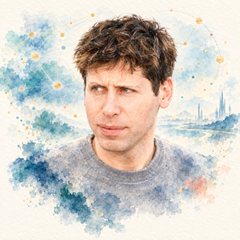 Sam Altman
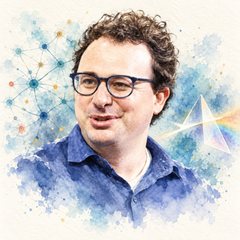 Dario Amodei
Where it stands. Contested. Marcus conceded in September 2026 that autoformalization "may finally be in reach, and maybe (?) reliable coding", two of the tasks in his bets; the Marcus-Brundage bet will be judged on ten tasks at the end of 2027. Source
Whether language models understand
Language models mimic the statistics of human text; similar outputs do not imply similar mechanisms, so their fluency is no evidence of understanding or inner experience.
Geoffrey Hinton told 60 Minutes in October 2023 that GPT-4 "definitely understands", and that such systems have experiences of their own "in the same sense as people do".
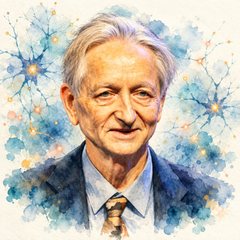 Geoffrey Hinton
Where it stands. Unresolved and partly definitional. In May 2026 Marcus wrote that Pope Leo XIV understood AI better than Hinton, after the Pope posted that "true comprehension comes from experience, not text approximation". Source
Credit for the critique of deep learning
LeCun's 2022 turn toward world models, common sense and reasoning restated arguments Marcus made in 2012 and 2018, which LeCun had called "mostly wrong", without attribution.
LeCun told ZDNet in September 2022 that "Gary Marcus is not an AI person, by the way, he is a psychologist," and that adding "symbolic reasoning on top of neural nets" was a misdirected idea; his own program, JEPA, learns world models without explicit symbols, and he has argued for decades that learned representations beat hand-built structure. Others note that critiques of pure deep learning predate both men.
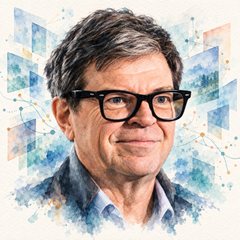 Yann LeCun
Where it stands. Personal as well as scientific. Marcus accused LeCun of "the plagiarism of ideas" in November 2025, and after LeCun joined the board of a reasoning startup in January 2026 claimed his rival had come round; LeCun maintains that his architecture is not symbolic AI. Source
Built-in structure versus learning from scratch
AlphaGo Zero's "tabula rasa" framing hides the search algorithm, architecture and rules its designers supplied; AI needs a deliberate theory of innate structure.
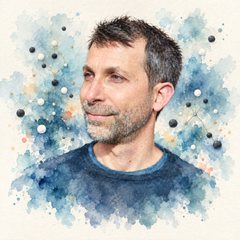
David Silver and his DeepMind colleagues say the point of AlphaZero and MuZero is that the same general algorithm, given only the rules or not even those, reached superhuman play in several games without human data, and that generic learning plus search scales where hand-built knowledge does not.
 David Silver
Where it stands. Both sides agree some structure is built in; they disagree on how much and of what kind, and the argument has since moved to language models. Source
How to govern frontier AI
Neither extinction panic nor deregulation; pre-release review by independent scientists, audits, liability and a dedicated agency, with a pause only where companies prove untrustworthy.
From one side, Geoffrey Hinton signed the Future of Life Institute's October 2025 statement calling for "a prohibition on the development of superintelligence" until there is broad scientific consensus that it can be done safely, the kind of blanket restriction Marcus called "too broad" when Sanders and Casar put it in a bill. From the other, Sam Altman told the Senate in May 2025 that a prior-approval process for models "would be disastrous" for American competitiveness, and Yann LeCun has argued that such rules rest on inflated estimates of near-term capability.
Where it stands. Moving partly his way. An executive order on pre-release checks in June 2026 and Amodei's September 2026 call to pace the frontier both echo proposals he made in 2023. Source
Notable works
| Title | Type | Year | Why it matters |
|---|---|---|---|
| Overregularization in Language Acquisition | paper | 1992 | Monograph of the Society for Research in Child Development, with Pinker, Ullman, Hollander, Rosen and Xu, analysing 11,521 past-tense forms from 83 children. |
| Rule learning by seven-month-old infants | paper | 1999 | Science paper with Vijayan, Bandi Rao and Vishton on infants generalizing abstract syllable patterns. |
| The Algebraic Mind: Integrating Connectionism and Cognitive Science | book | 2001 | MIT Press; the theoretical base for all of his later criticism of neural networks. |
| Kluge: The Haphazard Construction of the Human Mind | book | 2008 | Houghton Mifflin; argues that evolution left the mind with systematic flaws in memory and reasoning. |
| Guitar Zero: The New Musician and the Science of Learning | book | 2012 | Penguin Press; a New York Times bestseller about learning an instrument as an adult. |
| Is "Deep Learning" a Revolution in Artificial Intelligence? | essay | 2012 | The New Yorker, November 2012; the "better ladder" essay, his first public critique of deep learning. |
| Deep Learning: A Critical Appraisal | paper | 2018 | Ten concerns about deep learning, posted to arXiv in January 2018. |
| Rebooting AI: Building Artificial Intelligence We Can Trust | book | 2019 | With Ernest Davis (Pantheon); the case for common sense, causal models and hybrid systems. |
| The Next Decade in AI: Four Steps Towards Robust Artificial Intelligence | paper | 2020 | His research agenda for hybrid neurosymbolic systems. |
| Deep Learning Is Hitting a Wall | essay | 2022 | Nautilus essay whose title became shorthand for the scaling debate. |
| Testimony before the Senate Judiciary Subcommittee on Privacy, Technology and the Law | talk | 2023 | Written statement of 16 May 2023, opening with a GPT-4-generated fake news story about the Senate. |
| Taming Silicon Valley: How We Can Ensure That AI Works for Us | book | 2024 | MIT Press; his policy agenda for generative AI. |
Where to start
A short path into Gary's work, in order.
-
1
Deep Learning Is Hitting a Wallessay
The 2022 essay that made his case to a general audience, from radiologists to symbol manipulation; 20 minutes, and the source of the phrase everyone still argues about.
-
2
Testimony to the Senate Judiciary Subcommittee, May 2023essay
Five pages, including the GPT-4-written story about aliens in the Senate, that set out the policy program he still argues for; ten minutes.
-
3
Rebooting AI: Building Artificial Intelligence We Can Trustbook
With Ernest Davis; the fullest statement of what he thinks AI is missing (common sense, causal models, knowledge of time and space) and why, written for non-specialists.
-
4
Deep Learning: A Critical Appraisalpaper
The 2018 paper behind the public argument, with the ten concerns in technical form; an hour, and worth reading against what models did in the following eight years.
-
5
Taming Silicon Valley: How We Can Ensure That AI Works for Usbook
His 2024 policy book, short and direct, covering data rights, liability, transparency and oversight; the basis for most of his 2025 and 2026 commentary.
-
6
Marcus on AIessay
The newsletter where he publishes several times a week; read his annual prediction posts first to see how he scores himself.
Misconceptions
Marcus thinks AI can never reach human-level intelligence.
He expects AGI eventually and has offered his own definition of it; his claim is that current methods will not get there without symbolic reasoning and explicit knowledge. He wrote in January 2025 that "AI will presumably solve all of these someday, of course, but current techniques have thus far not been adequate." Source
Marcus wants to abandon deep learning.
His 2018 appraisal said "I don't think that we need to abandon deep learning" and proposed using it as "one tool among many" inside hybrid systems; he objects to treating it as sufficient on its own. Source
Marcus is an AI doomer.
He calls literal extinction "extremely unlikely" and has criticized doomers for underestimating human ingenuity; his warnings concern disinformation, cyberattacks and unreliable systems, and his remedies are regulatory rather than prohibitions on research. Source
Marcus has no background in AI.
LeCun made the claim in 2022; Marcus trained in cognitive science rather than computer science, but he founded Geometric Intelligence, directed Uber AI Labs, led a robotics AI startup as CEO, and has published peer-reviewed papers on commonsense reasoning with the computer scientist Ernest Davis, a list he sent to ZDNet in reply. Source
Awards
- Robert L. Fantz Award For new investigators in cognitive development.
- Fellow, Center for Advanced Study in the Behavioral Sciences, Stanford 2002-2003 fellowship.
- New York Times Book Review Editors' Choice For Kluge.
Quotes
"Deep learning is at its best when all we need are rough-ready results."
"We should all be deeply worried about systems that can fluently confabulate, unburdened by reality."
"The big tech companies’ preferred plan boils down to “trust us”."
"LLM researchers are NOT creating beings. They are creating interactive fiction that is trained to predict the language of actual beings."
"When real AGI arrives, we won’t need to squint our eyes."
"One extreme is absolutely zero regulation. Let AI rip, and hope for the best. Hope is not a strategy."
Related leaders
-
Yann LeCun
His longest-running opponent; by Marcus's account LeCun dismissed his 2018 appraisal of deep learning as "mostly wrong", LeCun told ZDNet in 2022 that Marcus "is not an AI person", and Marcus has accused LeCun of taking credit for critiques he made first, while welcoming LeCun's move toward world models and reasoning.
-
Geoffrey Hinton
The target of his 2012 "better ladder" essay and of "Deep Learning Is Hitting a Wall", which opened with Hinton's 2016 radiologist prediction; they disagree on whether language models understand.
-
Yoshua Bengio
Debated him in Montreal on 23 December 2019 over whether deep learning needs symbols; both signed the March 2023 pause letter, and they spoke at the same UN General Assembly event in September 2026.
-
Sam Altman
Testified beside him before the Senate on 16 May 2023; Altman mocked him as "a mediocre deep learning skeptic" in 2022 and posted "there is no wall" in 2024, and Marcus has called for OpenAI to be paused.
-
David Silver
Marcus's January 2018 paper argued that the "tabula rasa" framing of Silver's AlphaGo Zero understated the structure built into it.
-
Demis Hassabis
Says he shares Hassabis's strict definition of AGI, but in June 2026 contrasted his January estimate at Davos with the "2030 plus or minus a year" he gave at Stanford.
-
Dario Amodei
Gave Amodei's September 2026 essay on pacing the frontier "two cheers (out of three)" while disputing his forecasts of rapid capability gains.
-
Ilya Sutskever
Marcus cited Sutskever's November 2025 statement that "the age of scaling" was giving way to "the age of research" as support for his long-standing argument about diminishing returns.
-
Jensen Huang
Marcus criticized Huang's September 2026 declaration that AGI had arrived as coming "with no evidence and no definitions".
-
Mustafa Suleyman
Marcus has criticized his forecasts, from the 2023 claim that hallucinations would be "largely eliminated by 2025" to the February 2026 prediction that most computer-based professional tasks would be automated within 18 months.
Details and links
Education
- Bachelor's degree in Cognitive ScienceHampshire College, 1989
- PhD in Cognitive Science (adviser Steven Pinker)Massachusetts Institute of Technology, 1993
Affiliations
- New York University (Professor of Psychology and Neural Science, now Professor Emeritus)
- Marcus on AI newsletter (author, 2022-)
- Geometric Intelligence (Co-founder and CEO; acquired by Uber, December 2016)
- Uber AI Labs (Director, December 2016 to March 2017)
- Robust.AI (Co-founder and CEO, 2019)
- Center for Advanced Study in the Behavioral Sciences, Stanford (Fellow, 2002-2003)
Sources
- Gary Marcus - Wikipedia
- Gary Marcus - Substack profile (current bio, NYU Professor Emeritus)
- How to make AI work for us - On Point, WBUR (30 March 2026; guest bio, joining from Vancouver)
- Can This Man Make AI More Human? - MIT Technology Review (December 2015)
- Dr. Gary F. Marcus - Lifeboat Foundation bio (degrees, Fantz Award, CASBS fellowship)
- Overregularization in language acquisition - PubMed (1992)
- Rule learning by seven-month-old infants - PubMed (Science, January 1999)
- Guitar Zero, my wife says I was "cute but tuneless" - The Observer (June 2012)
- Is "Deep Learning" a Revolution in Artificial Intelligence? - The New Yorker (November 2012)
- Uber acquires Geometric Intelligence to create an AI lab - TechCrunch (December 2016)
- Head of Uber's Artificial Intelligence Labs Steps Down After Four Months - Fortune (March 2017)
- Deep Learning: A Critical Appraisal - arXiv (January 2018)
- Innateness, AlphaZero, and Artificial Intelligence - arXiv (January 2018)
- A Smoldering Conflict Flares - The Batch, DeepLearning.AI (December 2019)
- The Next Decade in AI: Four Steps Towards Robust Artificial Intelligence - arXiv (February 2020)
- Robust.AI raises a $15M Series A - TechCrunch (October 2020)
- Robust.AI - Leadership team
- Deep Learning Is Hitting a Wall - Nautilus (March 2022)
- Dialogue Origin, "Deep Learning Is Hitting a Wall" and "There Is No Wall" - Quote Investigator (January 2025)
- Sam Altman on X, "Give me the confidence of a mediocre deep learning skeptic" (8 April 2022)
- Meta's AI guru LeCun - ZDNet (September 2022)
- How new are Yann LeCun's "new" ideas? - Gary Marcus (September 2022)
- Dear Elon Musk, here are five things you might want to consider about AGI - Gary Marcus (May 2022)
- What to Expect When You're Expecting GPT-4 - Gary Marcus (December 2022)
- Pause Giant AI Experiments - Future of Life Institute (March 2023)
- Written testimony of Gary Marcus, Senate Judiciary Subcommittee on Privacy, Technology and the Law (16 May 2023)
- Where we are right now on open source and potential AI risk - Gary Marcus (November 2023)
- Taming Silicon Valley - Kirkus Reviews (publication date 24 September 2024)
- Where will AI be at the end of 2027? A bet - Gary Marcus and Miles Brundage (December 2024)
- 25 AI Predictions for 2025, from Marcus on AI (January 2025)
- GPT-5: Overdue, overhyped and underwhelming - Gary Marcus (August 2025)
- The False Glorification of Yann LeCun - Gary Marcus (November 2025)
- Ilya Sutskever, We're moving from the age of scaling to the age of research - Dwarkesh Podcast (25 November 2025)
- Six (or seven) predictions for AI 2026 - Gary Marcus (December 2025)
- Breaking, Yann LeCun, longtime critic of neurosymbolic approaches, changes teams - Gary Marcus (January 2026)
- The Pope appears to understand AI better than Geoffrey Hinton does - Gary Marcus (May 2026)
- Breaking, When dreams for AI sanity come true - Gary Marcus (2 June 2026)
- Sir Demis Hassabis vs Sir Demis Hassabis - Gary Marcus (June 2026)
- The new Sanders-Casar Ban Artificial Superintelligence Act, and why I oppose it - Gary Marcus (September 2026)
- Pause OpenAI, now - Gary Marcus (4 September 2026)
- Sad to see Jensen Huang claim that AGI has arrived - Gary Marcus (September 2026)
- Two cheers (out of three) for Dario Amodei - Gary Marcus (September 2026)
- Big news at the UN - Gary Marcus (21 September 2026)
- 60 Minutes interview with Geoffrey Hinton, transcript - CBS News (October 2023)
- GPT-4 Technical Report - OpenAI, arXiv (March 2023)
- System 2 deep learning: The next step toward artificial general intelligence - TechTalks (December 2019, Bengio at NeurIPS)
- How o3 and Grok 4 Accidentally Vindicated Neurosymbolic AI - Gary Marcus (July 2025)
- AI leaders at Davos on AGI and LLMs - Fortune (January 2026)
- Transcript, Senate Commerce hearing with Sam Altman - TechPolicy.Press (May 2025)
- Guitar Zero - Wikipedia (publication date and bestseller listing)
- Statement on Superintelligence - Future of Life Institute (October 2025)
- Promises are cheap - Gary Marcus
Reading this to shape your organization's AI plans? Through EMX, I help leadership teams decide where AI fits, what to ignore, and what to build next—using the same vendor-neutral research behind this profile. Put the research to work