The "Pause Giant AI Experiments" letter
An open letter asking every AI lab to stop training systems more powerful than GPT-4 for six months; Bengio signed it, Hinton and LeCun declined, and Gebru's DAIR answered that it aimed at the wrong risks.
What it was
The Future of Life Institute, a nonprofit that works on existential risks, dated the letter 22 March 2023 and made it public on 29 March. Its central request: "we call on all AI labs to immediately pause for at least 6 months the training of AI systems more powerful than GPT-4." It added that "If such a pause cannot be enacted quickly, governments should step in and institute a moratorium," and that labs and independent experts should use the time to write shared safety protocols, audited by outside experts.
Reuters reported on the day of publication that more than 1,000 people had signed, including Elon Musk, Stability AI chief executive Emad Mostaque, Yoshua Bengio and Stuart Russell, and that Sam Altman of OpenAI had not signed. The Institute's page later showed more than 31,000 signatures.
What it changed
OpenAI's chief executive Sam Altman said at MIT in April 2023 that the letter was "missing most technical nuance about where we need the pause," and that OpenAI was not training GPT-5 and "won't for some time." Several of the researchers profiled on this site answered it publicly, and have held the positions they took.
Bengio explained on 5 April 2023 that he "probably would not have signed such a letter a year ago," but that "there is an unexpected acceleration" in AI capabilities. Yann LeCun wrote on X on 29 March, "Nope. I did not sign this letter. I disagree with its premise," and on 7 April held a public conversation with Andrew Ng titled "Why the 6-month AI Pause is a Bad Idea." Geoffrey Hinton, who had just left Google to speak about AI risk, told CNN on 2 May that he had not signed "because if people in America stop, people in China wouldn't." On 31 March Timnit Gebru, Emily M. Bender and Angelina McMillan-Major, three of the listed authors of the 2021 "Stochastic Parrots" paper, published a statement on the site of Gebru's DAIR Institute arguing that the letter's "hypothetical risks are the focus of a dangerous ideology called longtermism that ignores the actual harms resulting from the deployment of AI systems today."
The arguments it moved
What are the biggest risks from AI?
The letter and the DAIR reply set out two different complaints about the AI industry. The letter asked whether we should "risk loss of control of our civilization"; the DAIR statement of 31 March 2023 replied that "The harms from so-called AI are real and present and follow from the acts of people and corporations deploying automated systems," and asked for regulation requiring transparency about training data and synthetic media. Bengio's April blog post explained his signature by the pace of progress. Two months later the Center for AI Safety's one-sentence statement on extinction drew signatures from lab leaders, including Altman, who had not signed the pause letter.
Who should set the rules for AI?
The letter asked governments to impose a moratorium if labs would not pause on their own, which raised the question of whether slowing down was possible at all. Hinton's answer in May 2023 was that a pause by American labs would not stop Chinese ones. LeCun and Ng's April 2023 conversation argued against a pause, pointing to the benefits AI was already bringing to fields such as education and healthcare.
Positions it bears on
-
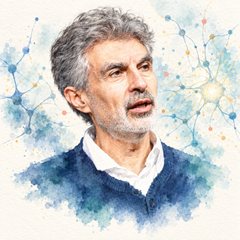
Yoshua Bengio, Pausing or pacing frontier AI
Signed the March 2023 call for a six-month pause on training systems beyond GPT-4 and the October 2025 statement calling for a prohibition on superintelligence; in September 2026 he framed the same idea as not training or deploying systems without a safety case that convinces independent experts.
Bengio signed the letter and explained on 5 April 2023 that the acceleration of capabilities had changed his mind.
-
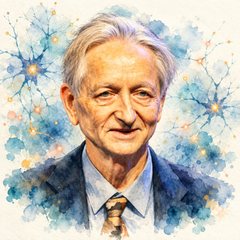
Geoffrey Hinton, Pausing or slowing AI development
Did not sign the March 2023 pause letter, on the grounds that competition between countries made slowing down infeasible; by 2025 and 2026 he was signing calls for a prohibition on superintelligence and telling lawmakers to slow down.
Hinton did not sign, telling CNN in May 2023 that a pause in America would not stop China.
-
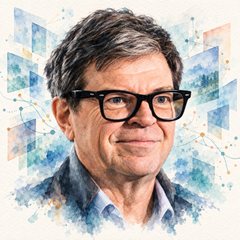
Yann LeCun, AI existential risk
Rejects the idea that AI poses an existential threat to humanity. He argues that intelligence does not imply a drive to dominate, that safety can be designed into systems through objectives and guardrails, and that catastrophic narratives rest on pessimism about people.
LeCun declined to sign, writing that he disagreed with the letter's premise.
-
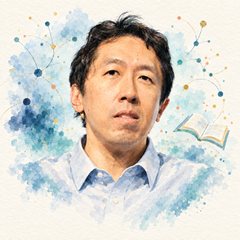
Andrew Ng, AI existential risk
Ng regards extinction scenarios as science fiction and argues that the fear is being manufactured, in part by companies seeking regulatory capture, and that it harms the field by scaring off students and distorting policy.
Ng joined LeCun on 7 April 2023 to argue that the six-month pause was a bad idea.
-
Timnit Gebru, AI existential risk and longtermism
Gebru argues that extinction scenarios are the product of a longtermist ideology and that they pull attention and policy away from harms that are already measurable, from exploited data workers to autonomous weapons.
Gebru co-wrote DAIR's 31 March 2023 response, which called the letter's focus on hypothetical risks a product of longtermism.
-
Gary Marcus, Regulation and independent oversight
Wants pre-release safety review of high-impact models by independent scientists, post-release audits with power to recall systems, liability for harms and a dedicated agency, nationally and internationally.
Marcus signed, telling Reuters that "the spirit is right" and that "we need to slow down," though his own program is independent pre-release review rather than a moratorium.

Sources
- Pause Giant AI Experiments, An Open Letter, Future of Life Institute
- Statement from the listed authors of Stochastic Parrots on the "AI pause" letter, DAIR Institute, 31 March 2023
- Slowing down development of AI systems passing the Turing test, Yoshua Bengio, 5 April 2023
- Musk, experts urge pause on training AI systems more powerful than GPT-4 (Reuters, via Malay Mail), 29 March 2023 (Internet Archive copy)
- Yann LeCun, post on X, 29 March 2023
- Yann LeCun and Andrew Ng, Why the 6-month AI Pause is a Bad Idea, DeepLearning.AI (YouTube), 7 April 2023
- AI pioneer Geoffrey Hinton says he did not sign the pause petition, CNN, 2 May 2023
- OpenAI's CEO confirms the company isn't training GPT-5 and 'won't for some time', The Verge, 14 April 2023