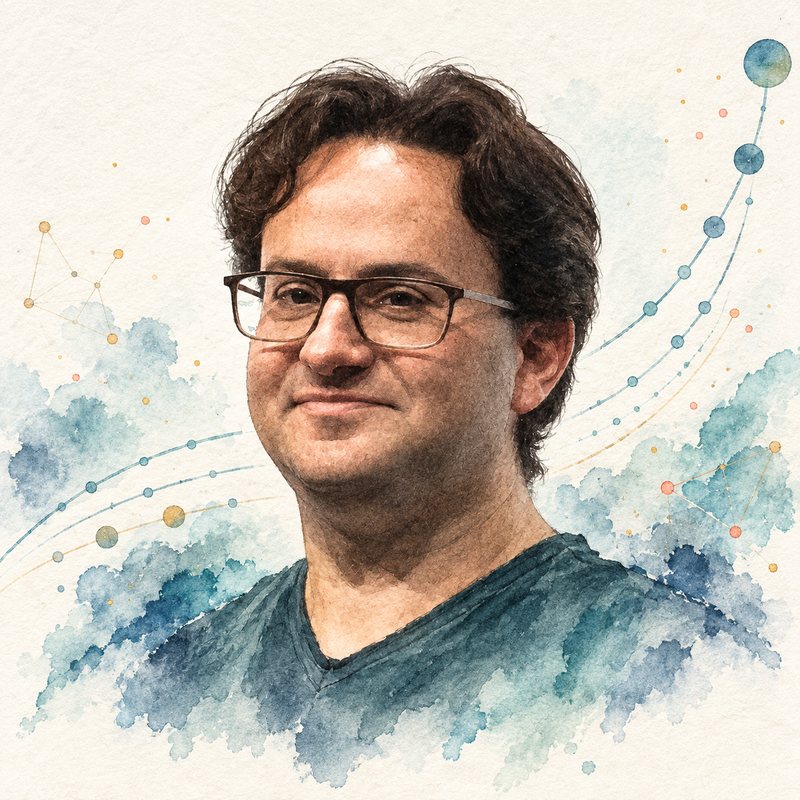
Jared Kaplan
Co-founder, Chief Science Officer and Responsible Scaling Officer, Anthropic
Physicist who led the 2020 scaling-laws paper, then co-founded Anthropic and now oversees its Responsible Scaling Policy.
Jared Kaplan is Anthropic's chief science officer and, since October 2024, its Responsible Scaling Officer, the executive who decides whether a model has met the safeguards the company's Responsible Scaling Policy requires before it is trained further or released. He took the role over from co-founder Sam McCandlish.
He spent roughly fifteen years as a theoretical physicist before touching machine learning. He studied physics and mathematics at Stanford, wrote a Harvard PhD on holography under Nima Arkani-Hamed (2009), held a postdoc at SLAC and Stanford, and joined the Johns Hopkins faculty in 2012, working on quantum gravity and conformal field theory. He remains on the Johns Hopkins faculty, where he has taught the foundations of deep learning.
At OpenAI, while still a professor, he led "Scaling Laws for Neural Language Models" (January 2020), which found that a language model's loss falls as a smooth power law in parameters, data and compute. The paper gave labs a way to budget for bigger models, and Kaplan was among the authors of the GPT-3 paper four months later and of OpenAI's 2021 Codex paper. He left with Dario Amodei's group at the end of 2020. In Anthropic's first months, he told Wired, all the founders did technical work, and he also ended up running payroll "because, well, someone had to do it."
At Anthropic he is the senior author of "Constitutional AI" (December 2022), the method of training a model to critique and revise its own answers against written principles, and he heads the company's technical research. In a December 2025 interview with The Guardian he said humanity would face a decision between 2027 and 2030 about whether to let AI systems train their successors.
Known for
Scaling Laws for Neural Language Models
First author of the January 2020 paper, with Sam McCandlish and Dario Amodei, showing that loss falls predictably as model size, data and compute grow, with some trends spanning more than seven orders of magnitude.
Constitutional AI: Harmlessness from AI Feedback
Senior author of the December 2022 paper in which a model is trained against a written list of principles, with AI feedback replacing most human labels of harmful output; it became the basis of the constitution Anthropic uses to train Claude.
Responsible Scaling Officer
Since October 2024 he has held the Anthropic role responsible for determining whether models meet the capability thresholds and safeguards set out in the Responsible Scaling Policy.
On the record
He says that letting AI systems recursively improve themselves, a decision he expects between 2027 and 2030, is the highest-stakes choice the field faces.
“is in some ways the ultimate risk, because it's kind of like letting AI kind of go”
Career
Sources
- Leadership at Anthropic (Anthropic, checked September 2026)
- Announcing our updated Responsible Scaling Policy (Anthropic, October 2024)
- Scaling Laws for Neural Language Models (Kaplan et al., arXiv, January 2020)
- Constitutional AI: Harmlessness from AI Feedback (Bai et al., arXiv, December 2022)
- 'The biggest decision yet': Jared Kaplan on allowing AI to train itself (The Guardian, December 2025)
- If Anthropic Succeeds, a Nation of Benevolent AI Geniuses Could Be Born (Wired, March 2025)
- Jared Kaplan (Wikipedia)
Brief profiles cover a person's professional record: roles, work and public statements, each from a source listed here. Full profiles, with positions across the debates, are kept for the people the site follows most closely.