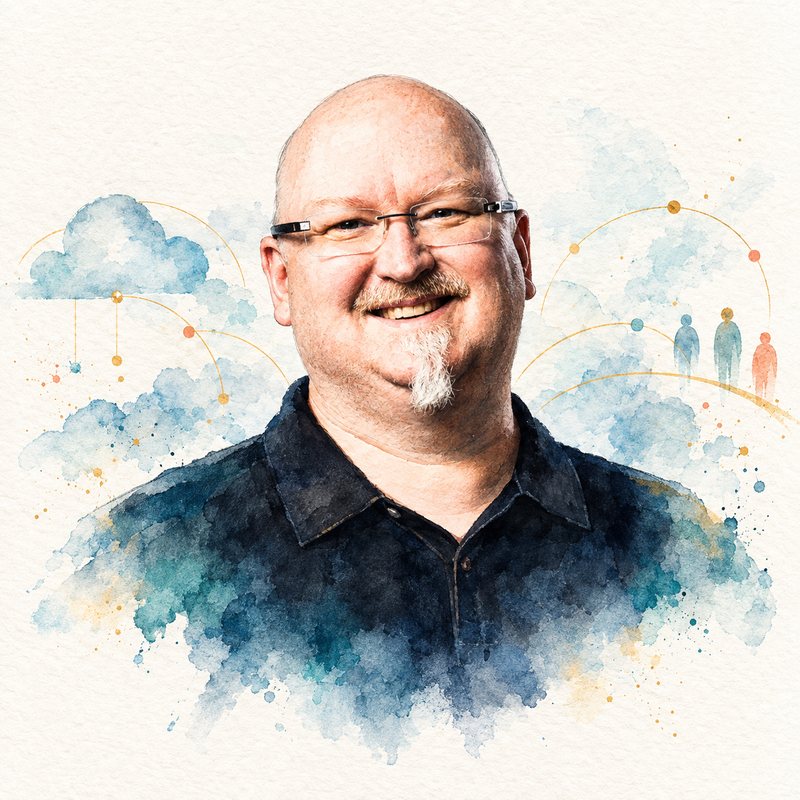
Kevin Scott
Chief Technology Officer and Executive Vice President of AI, Microsoft
Microsoft's CTO since 2017, who made the internal case for the 2019 OpenAI investment and runs its AI strategy.
Kevin Scott studied computer science at Lynchburg College and Wake Forest University and completed much of a PhD at the University of Virginia before leaving for Google, where he worked on search and ads and later ran mobile ads engineering after Google bought AdMob, the startup he had joined in 2007. At LinkedIn from 2011 he was senior vice president of engineering and operations through its public listing. Microsoft made him chief technology officer in January 2017, after it bought LinkedIn. His 2020 book with Greg Shaw, "Reprogramming the American Dream," draws on his rural Virginia hometown to argue that AI can serve people outside the tech hubs.
Scott was the executive who argued inside Microsoft for OpenAI. In a March 2018 email, shown at the Musk v. Altman trial in May 2026, he asked whether OpenAI's donors knew it planned a for-profit effort "on its back." On the stand he said he had meant his friend Reid Hoffman, not Elon Musk, and had been asking whether OpenAI could pursue the commercial plans it was pitching. By June 2019 he and finance chief Amy Hood asked the board to approve 1 billion dollars, writing that Google had pulled ahead and Microsoft was "scrambling to replicate" its results, and that Microsoft needed a "frontier AI workload" on Azure. The first joint supercomputer followed within six months and trained what became GPT-3.
When Nadella created Microsoft AI in March 2024, Scott kept responsibility, as CTO and executive vice president of AI, for "all-up AI strategy," including system architecture and partnerships. He has defended the scaling bet in public while warning about deployment. On the eve of Microsoft Build in June 2026 he said coding agents had advanced fastest because code gives tight feedback loops, and that "Just because we can make software go fast doesn't mean we can make organizations go fast."
Known for
The case for OpenAI
Wrote the 2019 memo, with Amy Hood, that took Microsoft's first 1 billion dollar investment in OpenAI to the board and tied it to building AI supercomputers on Azure.
Reprogramming the American Dream
A 2020 book with Greg Shaw arguing that AI, if widely deployed, could bring economic opportunity to rural and small-town America.
On the record
In July 2024 he said that larger models trained on bigger supercomputers were still improving at an exponential rate, against claims that scaling had stalled.
“despite what other people think, we're not at diminishing marginal returns on scale up.”
Career
-
until 2011
Google
Search and ads engineering; after Google bought AdMob, head of mobile ads engineering
-
2007-2010
AdMob
Vice president of engineering and operations
-
2011-2017
LinkedIn
Senior vice president of engineering and operations
-
2017-present
Chief Technology Officer; also Executive Vice President of AI
Sources
- Kevin Scott, Chief Technology Officer (Microsoft Source)
- Microsoft's CTO testifies about email at the heart of Elon Musk's allegations (GeekWire, May 2026)
- Mustafa Suleyman joins Microsoft to lead Copilot (Satya Nadella, Microsoft, March 2024)
- Microsoft CTO Kevin Scott on How Far Scaling Laws Will Extend (Sequoia Capital, July 2024)
- Kevin Scott: Why AI Capability May Not Create Real Value (The AI Economy, June 2026)
- Kevin Scott (computer scientist) (Wikipedia)
Brief profiles cover a person's professional record: roles, work and public statements, each from a source listed here. Full profiles, with positions across the debates, are kept for the people the site follows most closely.