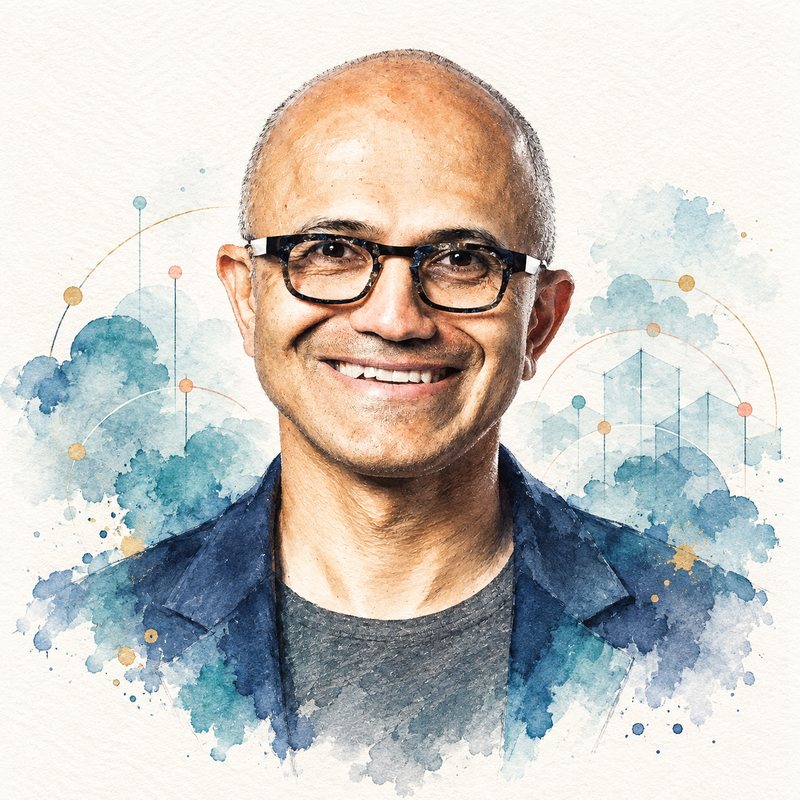
Satya Nadella
Chairman and Chief Executive Officer, Microsoft
Microsoft's chief executive since 2014, who made the 2019 bet on OpenAI and later built Microsoft's own frontier lab.
Satya Nadella grew up in Hyderabad, took an electrical engineering degree in India, a master's in computer science at the University of Wisconsin-Milwaukee and later an MBA at the University of Chicago. After working at Sun Microsystems he joined Microsoft in 1992, ran research and development for its online services and then its Cloud and Enterprise Group, which built Azure into the company's main business. He became chief executive in February 2014 and chairman in June 2021.
In 2019 he approved a 1 billion dollar investment in OpenAI after Kevin Scott and finance chief Amy Hood told the board Microsoft was "scrambling to replicate" Google's AI results. Testifying in Elon Musk's suit against OpenAI and Microsoft in May 2026, Nadella called the deal a "one-way door" and said, "We were outsourcing essentially a lot of the core IP development and taking a massive dependency on OpenAI." An April 2022 email shown at trial said he did not want Microsoft to become IBM while OpenAI became the next Microsoft. When OpenAI's board fired Sam Altman in November 2023, Nadella announced that Altman and Greg Brockman would join Microsoft to lead a new AI research team; Altman returned to OpenAI days later.
From 2024 Nadella hedged the OpenAI dependency. In March 2024 he hired Mustafa Suleyman and Karén Simonyan from Inflection to form Microsoft AI, and the October 2025 agreement let Microsoft pursue AGI on its own. In March 2026 he moved Copilot to Jacob Andreou so Suleyman could concentrate on models, writing that progress at the model layer "is more critical than ever to our success as a company over the next decade." At Davos in January 2026 he proposed a test for an AI bubble: "A telltale sign of if it's a bubble would be if all we are talking about are the tech firms." After Dario Amodei called in September 2026 for labs to slow capability gains together, Nadella wrote that Microsoft welcomed "deliberate pacing" and would open its model code of conduct to public comment.
Known for
The Microsoft-OpenAI partnership
Backed OpenAI with about 13 billion dollars from 2019 and built the Azure supercomputers that trained its GPT models, in exchange for licenses to its models and a stake that became about 27 percent in October 2025.
Microsoft AI and the MAI models
Created Microsoft AI under Suleyman in March 2024 and, after the 2025 and 2026 renegotiations with OpenAI, directed it to build Microsoft's own frontier models.
On the record
He has said AGI claims by labs matter less than whether AI measurably speeds up economic growth.
“Us self-claiming some AGI milestone, that's just nonsensical benchmark hacking to me. The real benchmark is: the world growing at 10%.”
In September 2026 he said any pursuit of superintelligence must keep AI under human control, and backed deliberate pacing and embedded evaluators on alignment.
“Any pursuit of superintelligence has to be grounded in the core principle that if the AI we build is not helping humanity and under human control, it's not worth pursuing”
Career
-
Sun Microsystems
Member of the technology staff
-
1992-present
Engineer and executive; executive vice president of the Cloud and Enterprise Group; chief executive from February 2014 and chairman from June 2021
Sources
- Satya Nadella, Chairman and CEO (Microsoft Source)
- OpenAI forms exclusive computing partnership with Microsoft (Microsoft, July 2019)
- A statement from Microsoft Chairman and CEO Satya Nadella (Microsoft, November 2023)
- Announcing Copilot leadership update (Microsoft, March 2026)
- Musk v. Altman: Satya Nadella was worried about Microsoft being 'the next IBM' in OpenAI deal (GeekWire, May 2026)
- Microsoft's CTO testifies about email at the heart of Elon Musk's allegations (GeekWire, May 2026)
- Satya Nadella's biggest AI bubble warning yet (Fortune, January 2026)
- Satya Nadella: Microsoft's AGI plan and quantum breakthrough (Dwarkesh Podcast, February 2025)
Brief profiles cover a person's professional record: roles, work and public statements, each from a source listed here. Full profiles, with positions across the debates, are kept for the people the site follows most closely.