Microsoft
Microsoft is the Redmond software and cloud company that bankrolled OpenAI from 2019, built the Azure supercomputers that trained its models and took about 27 percent of the company. Since March 2024 it has also had its own frontier effort, Microsoft AI, built from the staff of Inflection AI under Mustafa Suleyman, which trains the MAI models and pursues what he calls "humanist superintelligence." It is a public company led by Satya Nadella, and in September 2026 it put a draft code of conduct for its models out for public comment.
History
Microsoft Research and the first chatbots
Microsoft founded Microsoft Research in 1991, and it grew into one of the largest corporate research labs. Kai-Fu Lee set up its Beijing lab, later Microsoft Research Asia, in 1998. That lab produced one of the key deep learning papers of the decade: in December 2015 Kaiming He and three colleagues described residual networks, which used shortcut connections to train image classifiers 152 layers deep and won that year's ImageNet competition.
Microsoft's early consumer AI was less happy. In March 2016 it released Tay, a Twitter chatbot for 18- to 24-year-olds modeled on XiaoIce, a Chinese chatbot then used by about 40 million people. Within 24 hours a coordinated group of users had taught Tay to post offensive messages, and Microsoft took it offline. "We are deeply sorry for the unintended offensive and hurtful tweets from Tay," wrote Peter Lee, then head of Microsoft Research, adding that Microsoft had "made a critical oversight for this specific attack."
In January 2017 Microsoft made Kevin Scott, LinkedIn's head of engineering, its chief technology officer. By his own account in later court testimony, Microsoft was then behind Google in AI, and OpenAI had moved its computing from Azure to Google's cloud.
The OpenAI bet
In June 2019 Scott and finance chief Amy Hood asked Microsoft's board to invest 1 billion dollars in OpenAI. Their memo, later filed in court, said Google had used its own training infrastructure to pull ahead and Microsoft was "scrambling to replicate" the results, and that Azure needed a "frontier AI workload" to learn what to build. The deal was announced in July 2019. Within six months the two companies had built their first AI supercomputer, on which OpenAI trained GPT-3, and in October 2021 Microsoft also worked with NVIDIA to train the 530-billion-parameter Megatron-Turing NLG. A multiyear extension followed in January 2023, taking Microsoft's commitments to about 13 billion dollars.
Satya Nadella testified in May 2026 that the investment was a "one-way door," because Microsoft could not build two supercomputers, one for OpenAI and one for itself. "We were outsourcing essentially a lot of the core IP development and taking a massive dependency on OpenAI," he said. An April 2022 email shown at trial said he did not want Microsoft to become IBM while OpenAI became the next Microsoft.
The dependency was tested in November 2023, when OpenAI's board fired Sam Altman. Nadella announced that Altman and Greg Brockman would join Microsoft to lead a new AI research team, and Altman went back to OpenAI days later under a new board. Elon Musk later sued OpenAI and Microsoft, arguing that Microsoft had helped convert a charity into a for-profit business; Microsoft's lawyers argued that Musk had never objected to any stage of the partnership.
Inflection becomes Microsoft AI
On 19 March 2024 Nadella announced that Mustafa Suleyman, a co-founder of DeepMind, and Karén Simonyan would join Microsoft from Inflection AI to form Microsoft AI, with Suleyman as chief executive in charge of Copilot, Bing and Edge. Most of Inflection's staff followed. Microsoft paid Inflection about 650 million dollars, mostly to license its models, and did not buy the company.
Regulators asked whether the structure was a takeover in all but name. The US Federal Trade Commission opened an inquiry in June 2024 into whether the deal had been arranged to avoid merger review. Microsoft said its agreements let it "recruit individuals at Inflection AI" while "enabling Inflection to continue pursuing its independent business," and that it was "confident that we have complied" with reporting law. Britain's Competition and Markets Authority found in September 2024 that the hiring did amount to a merger under British law but cleared it, saying Inflection "had not been able to materially increase or sustain its chatbot user numbers."
Microsoft AI released its first in-house models in August 2025: MAI-Voice-1, a speech generator, and MAI-1-preview, a language model trained on about 15,000 NVIDIA H100 GPUs. The new division said it would keep using "the very best models from our team, our partners, and the latest innovations from the open-source community."
Rewriting the OpenAI deal
OpenAI's conversion into a public benefit corporation came with new terms for Microsoft. Under the agreement of 28 October 2025 Microsoft took about 27 percent of OpenAI Group PBC, valued at about 135 billion dollars, and kept rights to OpenAI's models and products through 2032. An independent expert panel would have to verify any OpenAI declaration of AGI, OpenAI committed to buy another 250 billion dollars of Azure services, Microsoft gave up its right of first refusal on OpenAI's computing, and "Microsoft can now independently pursue AGI alone or in partnership with third parties." Three weeks later Microsoft committed up to 5 billion dollars to Anthropic.
The relationship strained as each company moved onto the other's ground. In January 2026 Microsoft said about 45 percent of its 625 billion dollars of commercial contract backlog was tied to OpenAI. When Amazon agreed to invest up to 50 billion dollars in OpenAI in February 2026, the two partners issued a joint statement calling their partnership "strong and central." An OpenAI memo that April said the partnership had "limited our ability to meet enterprises where they are."
On 27 April 2026 they rewrote the deal again. Microsoft's license became non-exclusive through 2032, OpenAI could sell all its products through any cloud, and its revenue-share payments to Microsoft would continue through 2030 "independent of OpenAI's technology progress," subject to a cap. The clause tying Microsoft's rights to an AGI declaration disappeared. Amazon said the same day that it would offer OpenAI's models through its Bedrock service within weeks. A Microsoft executive testified in May that its total OpenAI-related spending was "upwards of $100 billion."
Humanist superintelligence and the pacing debate
On 6 November 2025 Suleyman announced the MAI Superintelligence Team, with Simonyan as chief scientist. His essay described systems "that are problem-oriented and tend towards the domain specific" and said Microsoft would "reject narratives about a race to AGI." On 17 March 2026 Nadella moved Copilot under Jacob Andreou writing that "Progress at the AI model layer is more critical than ever to our success as a company," and Suleyman said he would focus on delivering "world class models for Microsoft over the next 5 years." On 2 June 2026 Microsoft AI released seven models, including the reasoning model MAI-Thinking-1, and said, "We don't distill from other labs."
The spending drew questions. Microsoft's revenue for the year ended June 2026 was 331.8 billion dollars, and Azure passed 100 billion, but capital spending reached 41 billion dollars in a single quarter, free cash flow fell 23 percent and the shares had lost 19 percent in 2026 by late July. The Bank for International Settlements warned that June that hyperscalers' AI commitments were "outpacing earnings and the free cash flow of these firms." Microsoft's finance chief said demand signals justified more spending in fiscal 2027.
After Dario Amodei called in September 2026 for labs to slow capability gains together, Nadella wrote that Microsoft welcomed "deliberate pacing." On 14 September Microsoft AI published a draft code of conduct for its models for six weeks of public comment, stating that the models "will never resist human interruption, correction, or shutdown."
Timeline
-
Dec 2015
Residual networks paper
Microsoft Research Asia's 152-layer ResNet wins the 2015 ImageNet competition. Source
-
Mar 2016
Apology for Tay
Microsoft takes its Twitter chatbot offline after users teach it to post offensive messages. Source
-
Jul 2019
1 billion dollar investment in OpenAI
OpenAI makes Azure its exclusive cloud and the two companies agree to build AI supercomputers together. Source
-
Oct 2021
Megatron-Turing NLG with NVIDIA
Microsoft and NVIDIA train a 530-billion-parameter language model using DeepSpeed and Megatron. Source
-
Jan 2023
OpenAI partnership extended
A multiyear, multibillion-dollar investment takes Microsoft's commitments to about 13 billion dollars. Source
-
Sep 2023
Brad Smith backs licensing of frontier models
Microsoft's president tells a Senate subcommittee that self-regulation alone is not enough. Source
-
Nov 2023
Nadella says Altman will join Microsoft
After OpenAI's board fires Altman, Nadella announces a new team for him; Altman returns to OpenAI days later. Source
-
Mar 2024
Microsoft AI formed
Mustafa Suleyman and Karén Simonyan join from Inflection AI with most of its staff. Source
-
Jun 2024
FTC inquiry into the Inflection deal
Regulators examine whether the licensing-and-hiring deal was structured to avoid merger review. Source
-
Sep 2024
UK regulator clears the Inflection hiring
The CMA treats it as a merger but finds no realistic prospect of reduced competition. Source
-
Feb 2025
Frontier Governance Framework
Microsoft sets capability thresholds for weapons, cyber and autonomy risks and commits to pause if risks cannot be mitigated. Source
-
Aug 2025
First in-house MAI models
MAI-Voice-1 and MAI-1-preview, the latter trained on about 15,000 H100 GPUs. Source
-
Oct 2025
New agreement with OpenAI
Microsoft takes about 27 percent of OpenAI Group PBC and gains the right to pursue AGI on its own. Source
-
Nov 2025
MAI Superintelligence Team
Suleyman sets out "humanist superintelligence" as the team's goal. Source
-
Nov 2025
Invests in Anthropic
Microsoft commits up to 5 billion dollars and Anthropic agrees to buy Azure compute. Source
-
Mar 2026
Copilot moves to Jacob Andreou
Suleyman's organization concentrates on building Microsoft's own models. Source
-
Apr 2026
OpenAI deal rewritten
The license becomes non-exclusive through 2032 and the AGI clause is dropped. Source
-
May 2026
Nadella testifies in Musk v. Altman
He calls the OpenAI investment a "one-way door" that created a dependency Microsoft had to manage. Source
-
Jun 2026
Seven MAI models released
They include MAI-Thinking-1, which Microsoft AI says it trained without distilling other labs' models. Source
-
Jun 2026
Reid Hoffman to leave the board
The Inflection co-founder and former OpenAI director will not stand again at the 2026 annual meeting. Source
-
Jul 2026
Azure passes 100 billion dollars a year
Quarterly capital spending reaches 41 billion dollars, up 69 percent. Source
-
Sep 2026
Draft code of conduct for MAI models
Microsoft AI opens six weeks of public comment on rules its models are to follow. Source
-
Oct 2026
MAI-Base-2 finishes pre-training
Microsoft AI says the model, built without distilling other models, will let it license weights to trusted partners through Foundry; it is still in post-training. Source
What it built
The main models and products to come out of Microsoft, oldest first.
-
ResNet
Microsoft Research Asia's residual networks, 152 layers deep, won the 2015 ImageNet competition and became a standard building block.
-
DeepSpeed
An open-source training library whose ZeRO optimizer split model state across GPUs so that models with over 100 billion parameters could be trained.
-
GitHub Copilot
A coding assistant built on OpenAI Codex that suggested whole lines and functions inside the editor, one of the first mass-market AI products.
-
The new Bing
Search with a chat interface running on a customized OpenAI model that Microsoft said was more powerful than ChatGPT, pitched as a copilot for the web.
-
Phi-1
A 1.3-billion-parameter coding model trained on "textbook quality" data, the first of the Phi small models.
-
MAI-1-preview
Microsoft AI's first in-house foundation model, trained on about 15,000 H100 GPUs, released alongside MAI-Voice-1.
-
MAI-Thinking-1
A reasoning model released with six other MAI models, which Microsoft AI says it trained without distilling other labs' models.
Where it stands
The lab's own stated positions, from its charters, policies and official statements.
Microsoft's Frontier Governance Framework (February 2025) tracks chemical, biological, cyber and autonomy risks in its models and commits the company to stop work on a model whose risks it cannot reduce.
“If, during the implementation of this framework, we identify a risk we cannot sufficiently mitigate, we will pause development and deployment until the point at which mitigation practices evolve to meet the risk.”
Microsoft Frontier Governance Framework, version 1, 2025 · Compare the people on this
The draft code of conduct for MAI models (September 2026) says the models must stay under human direction, act only within authorized scope and never resist being stopped.
“The Code is designed to ensure MAI models will never resist human interruption, correction, or shutdown.”
Humanist AI in practice: A public consultation on our Code of Conduct for MAI Models (Microsoft AI), 2026 · Compare the people on this
In September 2023 Senate testimony Microsoft supported a licensing regime, run by an independent oversight body, for developers of highly capable frontier models, plus "safety brakes" for AI that controls critical infrastructure.
“the risks involved are too important, and their scale and potential impacts at present too unknowable, to address them through self-regulation alone.”
Written testimony of Brad Smith, Microsoft vice chair and president, to the Senate Judiciary Subcommittee on Privacy, Technology, and the Law, 2023 · Compare the people on this
Announcing its superintelligence team in November 2025, Microsoft AI said it was building domain-specific systems under human control and rejected the idea of a race to AGI.
“In doing this we reject narratives about a race to AGI, and instead see it as part of a wider and deeply human endeavour to improve our lives and future prospects.”
Towards Humanist Superintelligence (Mustafa Suleyman, Microsoft AI), 2025 · Compare the people on this
Responding to calls for pacing in September 2026, Nadella said the benefits of AI should spread across countries and companies, which required room for both closed and open models.
“This requires a frontier ecosystem in which both closed and open-source models can thrive”
Satya Nadella post on X, 13 September 2026, reported by NewsGram, 2026 · Compare the people on this
People
Here now
-
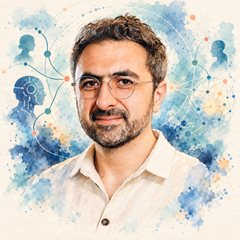
Mustafa Suleyman
Executive Vice President and CEO, Microsoft AI; leads the MAI Superintelligence Team, 2024-present
Co-founder of DeepMind and Inflection AI, author of The Coming Wave, and since March 2024 CEO of Microsoft AI, where since March 2026 he...
-
Karén Simonyan Brief profile
Chief Scientist, Microsoft AI; from November 2025 also chief scientist of the MAI Superintelligence Team, 2024-present
Co-created the VGG networks, worked on AlphaZero at DeepMind, co-founded Inflection; now Microsoft AI's chief scientist.
-
Kevin Scott Brief profile
Chief Technology Officer; also Executive Vice President of AI, 2017-present
Microsoft's CTO since 2017, who made the internal case for the 2019 OpenAI investment and runs its AI strategy.
-
Reid Hoffman Brief profile
Board director; not standing for re-election at the 2026 annual meeting, 2017-present
LinkedIn co-founder who funded and sat on OpenAI's board, co-founded Inflection AI and was a Microsoft director.
-
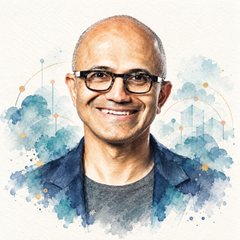
Satya Nadella Brief profile
Engineer and executive; executive vice president of the Cloud and Enterprise Group; chief executive from February 2014 and chairman from June 2021, 1992-present
Microsoft's chief executive since 2014, who made the 2019 bet on OpenAI and later built Microsoft's own frontier lab.



Formerly here
-
Nat Friedman Brief profile
Corporate Vice President, then Chief Executive Officer of GitHub, 2016-2021
Ran GitHub when it launched Copilot, co-funded the Vesuvius Challenge, and has led Meta's AI products since 2025.

Where its people went
Organizations founded by people who left Microsoft.
-
01.AI
Kai-Fu Lee
Lee founded Microsoft's Beijing research lab in 1998, left Microsoft for Google in 2005 and in 2023 founded 01.AI, whose open Yi models made it a unicorn within eight months. Source
-
xAI
Greg Yang
Yang, whose Tensor Programs work at Microsoft Research produced a method for tuning very large networks, left to join Elon Musk's founding team at xAI in July 2023. Source
Sources
- About Microsoft Research (Microsoft)
- Learning from Tay's introduction (Peter Lee, Microsoft, March 2016)
- OpenAI forms exclusive computing partnership with Microsoft (Microsoft, July 2019)
- Written testimony of Brad Smith (US Senate Judiciary Committee, September 2023)
- Mustafa Suleyman, DeepMind and Inflection co-founder, joins Microsoft to lead Copilot (Satya Nadella, Microsoft, March 2024)
- FTC launches an antitrust probe into Microsoft's deal with Inflection AI (Engadget, June 2024)
- CMA clears Microsoft's hiring of Inflection leadership (The Register, September 2024)
- Microsoft Frontier Governance Framework (Microsoft, February 2025)
- The next chapter of the Microsoft-OpenAI partnership (Microsoft, October 2025)
- Towards Humanist Superintelligence (Mustafa Suleyman, Microsoft AI, November 2025)
- Announcing Copilot leadership update (Microsoft, March 2026)
- The next phase of the Microsoft-OpenAI partnership (Microsoft, April 2026)
- OpenAI shakes up partnership with Microsoft, capping revenue share payments (CNBC, April 2026)
- Musk v. Altman: Satya Nadella was worried about Microsoft being 'the next IBM' in OpenAI deal (GeekWire, May 2026)
- Microsoft's CTO testifies about email at the heart of Elon Musk's allegations (GeekWire, May 2026)
- Building a hill-climbing machine: Launching seven new MAI models (Microsoft AI, June 2026)
- Microsoft jumps 8% as it boosts capital spending plans, citing demand (CNBC, July 2026)
- How the AI bubble could pop and take down the global economy, according to the BIS (The Register, June 2026)
- Humanist AI in practice: A public consultation on our Code of Conduct for MAI Models (Microsoft AI, September 2026)
- AI Not Worth Pursuing Unless it Helps Humanity, Satya Nadella (NewsGram, September 2026)
- Frontier Pre-training at Microsoft AI (Microsoft AI, 15 October 2026)