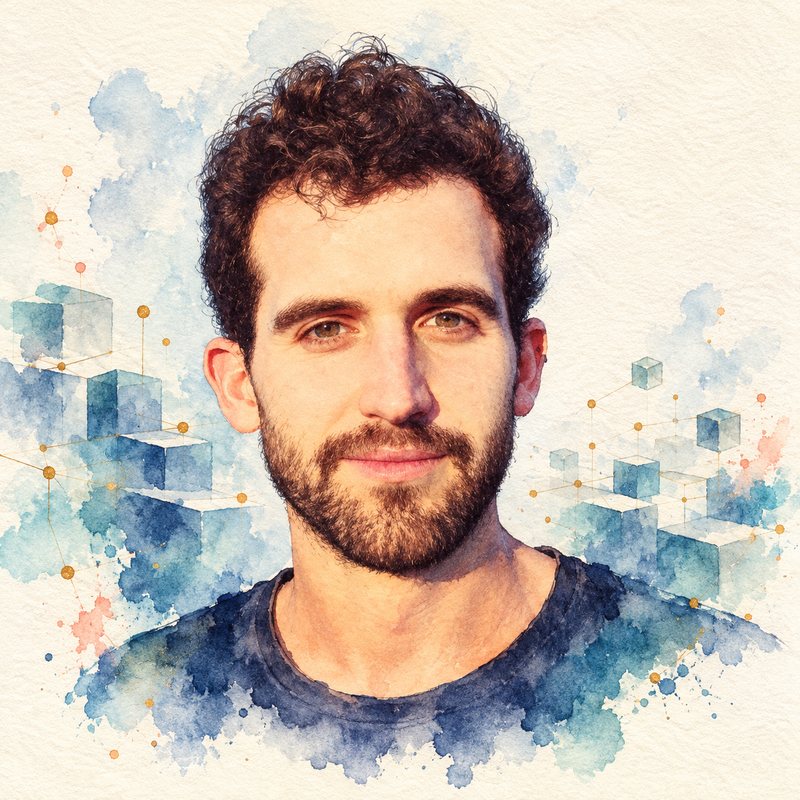
Tom Brown
Co-founder and Chief Compute Officer, Anthropic
Led the engineering of GPT-3 and was first author of its paper; now runs Anthropic's compute.
Tom Brown co-founded Anthropic and is its Chief Compute Officer, leading the technical organization that, in Anthropic's words, is responsible for "securing, scaling, and effectively using its compute resources." The job grew with the company's appetite for chips: in October 2025 Anthropic announced plans for up to one million Google TPUs, worth tens of billions of dollars, and weeks later a 50 billion dollar data-center program in Texas and New York. Brown has called the effort "humanity's largest infrastructure buildout ever."
The route to that job ran through startups. After an MEng at MIT in computer science with a focus on brain and cognitive sciences, Brown was an early employee at MoPub, the mobile-ad company Twitter later bought, and then co-founded Grouper, a Y Combinator company (Winter 2012) that arranged drinks between two groups of three friends. Brown then taught himself machine learning; Y Combinator's Lightcone podcast introduced Brown in August 2025 as a self-taught engineer who once got a B-minus in linear algebra.
Brown was a co-author, with Paul Christiano, Jan Leike and Dario Amodei, of the June 2017 paper "Deep reinforcement learning from human preferences," the origin of the RLHF technique used to turn base models into assistants. A stint at Google Brain produced "Adversarial Patch" (December 2017), a printable sticker that made image classifiers see a toaster. Back at OpenAI, Brown led the engineering of GPT-3 and was first author of its May 2020 paper, "Language Models are Few-Shot Learners," written with 30 colleagues. Brown also co-wrote the scaling-laws paper that justified the model's size, and left with Dario Amodei's group at the end of 2020.
Known for
GPT-3
First author of "Language Models are Few-Shot Learners" (May 2020), which introduced the 175-billion-parameter model and showed that a large enough model could learn tasks from a few examples in its prompt; Anthropic credits Brown with leading its engineering.
Learning from human preferences
Co-author of the 2017 paper that trained agents from human comparisons of their behavior rather than a hand-written reward; Anthropic's biography describes Brown as a co-inventor of RLHF with Dario Amodei.
Adversarial Patch
First author of the December 2017 Google paper showing that a small printed patch placed in a scene could force an image classifier to report a chosen class.
Career
Sources
- Leadership at Anthropic (Anthropic, checked September 2026)
- Tom Brown profile (Forbes, updated September 15, 2026)
- Anthropic Co-founder: Building Claude Code, Lessons From GPT-3 and LLM System Design (Y Combinator Lightcone podcast, August 2025)
- Lightcone episode description (Listen Notes, August 2025)
- Grouper company page (Y Combinator)
- Language Models are Few-Shot Learners (Brown et al., arXiv, May 2020)
- Adversarial Patch (Brown et al., arXiv, December 2017)
- Expanding our use of Google Cloud TPUs and Services (Anthropic, October 23, 2025)
Brief profiles cover a person's professional record: roles, work and public statements, each from a source listed here. Full profiles, with positions across the debates, are kept for the people the site follows most closely.