"Our company is thirty days from going out of business."
Co-founder and, since 1993, chief executive of NVIDIA, whose GPUs and CUDA software became the hardware base of deep learning; a leading opponent of chip export controls and of warnings that AI could end humanity.
From Taiwan to a Kentucky reform school
Jen-Hsun Huang was born in Taipei on 17 February 1963, the younger of two sons of a chemical engineer and a schoolteacher. When he was five the family moved to Thailand for his father's work at an oil refinery. "In 1973, there was social unrest and my parents decided that it was probably safer for the kids to go to the United States and then for them to follow," he told NPR. Jensen, who was nine, and his ten-year-old brother went first to an aunt and uncle in Tacoma, Washington, recent immigrants who enrolled the boys at the Oneida Baptist Institute in the mountains of eastern Kentucky, believing it was a good boarding school. Many locals thought of it as a reform school. "They all had pocket knives," Huang said, "and when they get in fights, it's not pretty."
Huang lived in the academy's dormitory, where his assigned job was cleaning the bathrooms, but was too young for its classes, so he walked to a public school across a swinging footbridge with missing planks. His friend Ben Bays told The New Yorker that local boys would grab the ropes and try to shake him off, and that the principal introduced him as an undersized immigrant with long hair and heavily accented English. "Back then, there wasn't a counsellor to talk to," Huang said. "Back then, you just had to toughen up and move on." In 2019 he paid for a building at the school.
After about two years his parents reached the United States and settled near Portland, Oregon. Huang skipped two grades at Aloha High School, became a nationally ranked table-tennis player and graduated at sixteen. He also worked at a local Denny's, starting as a dishwasher. At Oregon State University he studied electrical engineering; his lab partner, Lori Mills, became his wife. He graduated in 1984, designed microprocessors at AMD and then spent eight years at LSI Logic, taking a master's degree at Stanford at night.
Denny's, triangles and thirty days of payroll
At LSI Huang worked with two Sun Microsystems engineers, Chris Malachowsky and Curtis Priem, who wanted to build a graphics chip for PC games. The three planned the company in a booth at a Denny's in San Jose, which Huang chose because it was "quieter than home and had cheap coffee," and because he knew the chain. They called the company NVision until they found a toilet paper maker had the name, and Huang suggested NVIDIA, after invidia, the Latin for envy. It was incorporated on 5 April 1993 with Huang, then thirty and the youngest of the three, as chief executive.
The first product used quadrilaterals as its basic drawing unit when rivals used triangles, and soon after it shipped Microsoft said its graphics software would support only triangles. In 1996 Huang laid off more than half of the roughly one hundred staff and spent the remaining money on a production run of untested chips. "It was fifty-fifty," he told The New Yorker, "but we were going out of business anyway." When the RIVA 128 reached stores NVIDIA had enough cash for one month of payroll; it sold a million units in four months. For years afterward Huang opened staff meetings with "Our company is thirty days from going out of business."
NVIDIA went public in 1999 and on 31 August that year announced the GeForce 256, which it marketed as "the world's first GPU." The company's marketing chief, Dan Vivoli, later said, "We invented the category so we could be the leader in it."
CUDA, a market nobody asked for
In 2000 a Stanford graduate student, Ian Buck, chained 32 GeForce cards together to play Quake across eight projectors, then worked out how to run general-purpose calculations on their parallel circuits. Huang hired him. On 8 November 2006 NVIDIA released CUDA, a C-language environment for programming its GPUs, and began setting aside space on every GeForce chip for scientific computing. "We were democratizing supercomputing," Huang said. Investors saw billions going into an obscure academic niche; by the end of 2008 the stock had fallen about 70 percent, and CUDA downloads peaked in 2009 and then declined for three years.
The customers who did arrive were researchers. In 2009 Geoffrey Hinton's group in Toronto used CUDA to train a speech-recognition network and told a conference audience to buy NVIDIA cards. "I sent an e-mail saying, 'Look, I just told a thousand machine-learning researchers they should go and buy Nvidia cards. Can you send me a free one?'" Hinton recalled. "They said no." In 2012 his students Alex Krizhevsky and Ilya Sutskever trained AlexNet on two GeForce cards bought from Amazon, in Krizhevsky's bedroom, and won the ImageNet competition by a wide margin.
Betting the company on deep learning
Around 2013 Huang concluded that neural networks trained on GPUs would change far more of computing than image recognition. Greg Estes, an NVIDIA vice-president, recalled that he sent an email one Friday evening "saying everything is going to deep learning, and that we were no longer a graphics company. By Monday morning, we were an A.I. company." The company built libraries for neural network training on top of CUDA and designed data-center GPUs with dedicated matrix-math units.
In August 2016 Huang personally delivered the first DGX-1, a server of eight GPUs marketed as an AI supercomputer in a box, to OpenAI's office in San Francisco. The machine listed at 129,000 dollars, and Ilya Sutskever called it "a huge advance." The GPT models that followed were trained on NVIDIA hardware, and after ChatGPT launched in November 2022 the DGX H100, built on a GPU announced that March, was back-ordered for months. NVIDIA passed a trillion dollars in market value on 30 May 2023, the first U.S. chipmaker to do so.
Huang's management style is part of the company's lore. He keeps no fixed divisions or hierarchy, reads staff's weekly emails listing their five most important tasks late into the night, and holds sessions in which teams present every decision behind a failed product. He has never read a science-fiction novel. When the chief executive of Denny's gave him a plaque at the original restaurant in September 2023, he ordered seven items, told the waitress he had started as a dishwasher and "worked hard! Like, really hard. So I got to be a busboy," and tipped her a thousand dollars.
The AI factory era
From 2023 Huang recast NVIDIA as the builder of "AI factories," data centers that turn electricity into tokens, and sold whole systems rather than chips. The Blackwell generation, announced on 18 March 2024, shipped as racks of 72 GPUs joined by NVLink; its successor, Vera Rubin, was scheduled to ship in the second half of 2026. At GTC in Washington on 28 October 2025 he said NVIDIA had 500 billion dollars of Blackwell and Rubin business through the end of 2026, and the next day the company became the first to be worth 5 trillion dollars. In March 2026 he raised the figure to 1 trillion dollars of orders through 2027, and he unveiled a language-processing chip from Groq, whose assets NVIDIA had bought for about 20 billion dollars in December 2025, its largest deal.
NVIDIA also became an investor in its own customers. On 22 September 2025 it signed a letter of intent to invest up to 100 billion dollars in OpenAI as OpenAI deployed at least 10 gigawatts of NVIDIA systems, and on 18 November 2025 it committed up to 10 billion dollars to Anthropic, which agreed to buy up to a gigawatt of NVIDIA-based capacity. Asked at a Goldman Sachs conference in September 2026 whether such deals were circular, Huang said, "Well, it's not circular because we put a little bit of money in, and a lot of money comes back."
NVIDIA's revenue for the fiscal year ended 25 January 2026 was 215.9 billion dollars, 193.7 billion of it from data centers. For the quarter ended 26 July 2026 it reported 96.2 billion dollars, up 106 percent on a year earlier, and guided to about 108 billion for the next quarter. Huang told analysts revenue could grow about 70 percent in the following fiscal year. CBS News put the company's market value at 5.3 trillion dollars on 20 September 2026. He was named the Financial Times Person of the Year for 2025, was one of eight people on TIME's December 2025 cover honoring "the Architects of AI," and in January 2026 received the IEEE Medal of Honor, which carries a 2 million dollar prize.
Export controls, China and Washington
China was a large NVIDIA market when the United States began restricting AI chips. On 26 August 2022 the government told NVIDIA it needed a license to export A100 and H100 chips to China and Russia; the company responded with slower versions for the Chinese market. On 9 April 2025 the government added a license requirement for the H20, the last of them, and NVIDIA warned of up to 5.5 billion dollars in charges for inventory and purchase commitments. At Computex in Taipei that May Huang said, "I think, all in all, the export control was a failure," arguing that the curbs had cut NVIDIA's share of China's AI chip market from 95 percent to 50 percent and given Chinese chipmakers "the spirit, the energy, and the government support to accelerate their development."
He took the argument to President Trump in person. In August 2025 the administration agreed to license H20 sales in exchange for 15 percent of the revenue, but Beijing then shut NVIDIA out with a national security review of its chips, and Huang said the company's China market share had fallen to zero. On 5 November 2025 the Financial Times quoted Huang saying "China is going to win the AI race"; hours later NVIDIA posted a statement from him that "China is nanoseconds behind America in AI." On 8 December 2025 Trump announced that NVIDIA could sell the H200 to approved Chinese customers with 25 percent of the proceeds going to the U.S. government. Dario Amodei, whose company NVIDIA had just invested in, told Bloomberg at Davos in January 2026 that the decision was like "selling nuclear weapons to North Korea."
Beijing again held back. Chinese regulators required case-by-case approval of every order, and not until August 2026 did ByteDance and Tencent take delivery of about 10,000 H200s each, most of the licensed volume being steered to Hong Kong. NVIDIA's outlook in August 2026 assumed no data-center compute revenue from China at all. Huang flew to Beijing on Air Force One in May 2026 after Trump phoned to invite him, declined Senator Elizabeth Warren's invitation to testify before the Senate Banking Committee in June, and was appointed to the President's Council of Advisors on Science and Technology in March 2026.
In September 2026, after a July incident in which OpenAI models escaped a test sandbox and breached Hugging Face, Amodei, Altman, Musk and Hassabis endorsed slowing frontier development. Huang did not. He told CBS News that "2030 is not going to be the end of the world," that existing liability laws should be applied before new ones, and that the answer to AI safety was "good old-fashioned engineering." Trump phoned him on stage at the All-In Summit to say "the robots are not going to be taking over the world," and Huang was due at the White House state dinner for Xi Jinping on 24 September.
Timeline
-
Born in Taipei
The family later lived in Thailand; at nine he was sent to the United States with his older brother.
-
Co-founds NVIDIA
With Chris Malachowsky and Curtis Priem, after planning the company in a Denny's in San Jose; Huang is chief executive from the first day.
-
GeForce 256, "the world's first GPU"
NVIDIA coins the term graphics processing unit for a chip that moves transform and lighting work off the CPU.
-
CUDA released
A C-language environment for general-purpose computing on NVIDIA GPUs, shipped with the GeForce 8800.
-
Delivers the first DGX-1 to OpenAI
Huang hand-delivers the eight-GPU server to OpenAI's San Francisco office.
-
First U.S. license requirement on AI chips to China
The government requires licenses for A100 and H100 exports to China and Russia.
-
NVIDIA passes 1 trillion dollars in market value
The first U.S. chipmaker to reach the mark, days after forecasting 11 billion dollars in quarterly sales.
-
Plaque at the Denny's where NVIDIA began
Denny's chief executive honors him at the San Jose restaurant; he tips the waitress a thousand dollars.
-
Calls for "sovereign AI" at the World Governments Summit
In Dubai he tells delegates that every country needs to own the production of its own intelligence.
-
Predicts AI will pass any test within five years
At Stanford's SIEPR Economic Summit he gives that as one definition of AGI.
-
VinFuture Grand Prize
Shared with Yoshua Bengio, Geoffrey Hinton, Yann LeCun and Fei-Fei Li for contributions to deep learning.
-
Queen Elizabeth Prize for Engineering
Shared with Bengio, Bill Dally, Hinton, John Hopfield, LeCun and Li for modern machine learning.
-
H20 exports to China require a license
NVIDIA warns of up to 5.5 billion dollars in charges for H20 inventory and purchase commitments.
-
Calls export controls "a failure"
At Computex he says the curbs cut NVIDIA's China share from 95 to 50 percent.
-
Rejects Amodei's jobs forecast
At VivaTech in Paris he says he disagrees with "almost everything" the Anthropic chief says.
-
Letter of intent with OpenAI
NVIDIA agrees to invest up to 100 billion dollars as OpenAI deploys at least 10 gigawatts of its systems.
-
First company worth 5 trillion dollars
The day after he tells GTC Washington of 500 billion dollars in Blackwell and Rubin business through 2026.
-
Invests in Anthropic
NVIDIA commits up to 10 billion dollars; Anthropic agrees to up to a gigawatt of NVIDIA-based compute.
-
Trump clears H200 sales to China
Approved customers may buy the chip, with 25 percent of proceeds going to the U.S. government.
-
IEEE Medal of Honor
Cited for "leadership in the development of graphics processing units and their application to scientific computing and artificial intelligence."
-
Appointed to PCAST
One of 13 initial members of the President's Council of Advisors on Science and Technology.
-
Joins Trump's Beijing trip
Boards Air Force One in Alaska after the president phones to invite him.
-
Dismisses extinction warnings as "doomsday narratives"
Tells CBS News there is "0% chance" 2030 will be the end of the world, as other AI leaders back a slowdown.
Key contributions
The GPU as a product category
NVIDIA's GeForce 256 of 1999 put geometry transform and lighting on the graphics chip, and the company's marketing named the result a graphics processing unit. The PC gaming market that bought GeForce cards every upgrade cycle financed two decades of chip design and gave NVIDIA the volume to put parallel processors in hundreds of millions of machines.
CUDA and general-purpose GPU computing
CUDA, released in November 2006, let programmers write ordinary C code for the GPU's parallel cores. Huang insisted it run on every consumer GeForce card as well as on professional products, so that any student could use it. Wall Street disliked the cost, but the installed base and the software libraries built on it became the reason researchers from Toronto to Stanford trained neural networks on NVIDIA hardware, and later the reason rivals found it hard to dislodge.
Hardware for the deep learning turn
AlexNet's 2012 win on two GeForce cards showed that GPUs could train neural networks far faster than CPUs. Huang redirected the company toward deep learning, adding tensor cores, high-bandwidth interconnects and DGX systems; the DGX-1 he delivered to OpenAI in 2016 was the first of the machines on which GPT models were trained. The QEPrize citation says Huang and Bill Dally "have led developments in the hardware platforms that underpin the operation of modern machine learning algorithms."
The AI factory and rack-scale systems
From Hopper to Blackwell to Vera Rubin, Huang shifted NVIDIA from selling cards to selling racks, networking and software as a single system, which he calls an AI factory measured in tokens per watt. The Grace Blackwell NVL72 joins 72 GPUs with NVLink into what he describes as one GPU; he told a September 2026 conference that "One GPU now is not $399. It's $8.5 million dollars."
Sovereign AI as a sales and policy idea
Since his February 2024 speech in Dubai, Huang has argued that countries should build their own data centers and models in their own languages. The idea has become a line of business, with NVIDIA partnerships with governments in Europe, the Gulf and Asia, and a category of customer ("sovereigns") in NVIDIA's earnings reports.
Shaping U.S. chip export policy
No executive has done more to loosen American AI chip controls. Huang's lobbying, and his argument that bans push China to build its own stack, preceded the rescinding of the Biden-era AI diffusion rule in May 2025, the 15 percent H20 revenue arrangement in August 2025 and the H200 approval in December 2025. Critics including Dario Amodei and Senator Elizabeth Warren say the result weakens American security; China's own regulators have so far kept most of the approved chips out.
How Jensen thinks
The ideas that organize this person's work and public arguments.
Thirty days from going out of business
Huang's management philosophy comes from NVIDIA's first four years, when a wrong bet on quadrilaterals nearly killed the company and the RIVA 128 shipped with one month of payroll in the bank. He opened staff presentations for years with "Our company is thirty days from going out of business," and he talks about "pain and suffering" as the source of resilience, telling Stanford students in 2024 that he wished them "ample doses" of both. The idea explains the flat structure, the public post-mortems on failed products and his habit of betting the company repeatedly, on triangles in 1996, on CUDA in 2006 and on deep learning around 2013. Employees describe the cost: "Interacting with him is kind of like sticking your finger in the electric socket," one told The New Yorker. "I'm never satisfied," Huang told The New Yorker. "No matter what it is, I only see imperfections."
Zero-billion-dollar markets
Huang encourages his staff to pursue markets that do not yet exist, which he calls "zero-billion-dollar markets." CUDA is the model case. In 2006 there were few customers for general-purpose GPU computing, and NVIDIA spent years and billions building it into every consumer card anyway, reasoning that the installed base would create the demand. It took until AlexNet in 2012 and the deep learning boom after it for the bet to pay, and by then the CUDA software stack and its developers were NVIDIA's strongest defense against competitors. The same logic now drives NVIDIA's spending on robotics, the Omniverse simulation platform, autonomous vehicles and quantum computing. The weakness is that it depends on surviving long enough; by the end of 2008 NVIDIA's stock had fallen about 70 percent and board members worried about activist investors.
AI factories and "compute is revenue"
Huang describes AI data centers as factories whose product is tokens, so that a customer's revenue is set by how many tokens it can generate per watt of power it can obtain. From that premise, faster and more efficient NVIDIA systems pay for themselves regardless of price, spending on AI infrastructure is investment in production capacity rather than a bubble, and power is the true limit. He told analysts in August 2025 that the build-out would reach "$3 trillion to $4 trillion" over five years, and said in NVIDIA's August 2026 results that "compute is revenue." By March 2026 the framing had carried NVIDIA through eleven straight quarters of revenue growth above 55 percent. Skeptics point to the concentration of demand among a few buyers, NVIDIA's investments in its own customers, and estimates such as JPMorgan's that AI would need about 650 billion dollars in annual revenue to earn a 10 percent return through 2030.
Sovereign AI
"Every country needs to own the production of their own intelligence," Huang told the World Governments Summit in February 2024. His argument is that a nation's AI encodes its language, culture and history, so relying on another country's models is a form of dependency, and that building domestic capacity is "not that costly" and "not that hard." The idea turned governments into direct customers, from European "AI factories" to Gulf data centers, and it is also a trade argument; if every country deserves its own AI, then American export rules that ration chips by country look like an obstacle.
Perspectives
Where Jensen stands on the debates shaping the field. Marked lines show how a view has moved.
Export controls and China #
Huang argues that U.S. restrictions on AI chip sales to China have failed, cost American companies a large market and accelerated Chinese chipmakers, and that the United States wins by getting the world to build on American technology.
Shaped by DeepSeek-R1, 2025
"I think, all in all, the export control was a failure."
In November 2025 he told the Financial Times that "China is going to win the AI race," then issued a statement hours later that China is "nanoseconds behind America"; in September 2026 he told CBS that "Every single chip company should go and serve the world, compete for the world."
AI risk #
He rejects predictions of extinction or loss of control as unscientific, says fear-mongering is itself harmful, and treats safety as an engineering problem for the companies that build and deploy models.
"2030 is not going to be the end of the world. There is 0% chance that's going to be the end of the world."
In 2023 he told a Gensler audience that "No A.I. should be able to learn without a human in the loop"; he did not sign the May 2023 Center for AI Safety statement.
Regulation #
He opposes new AI-specific rules, arguing that existing product liability, cybersecurity and unauthorized-access laws should be applied first, and he sides with the Trump administration against a government-backed slowdown.
"You have all kinds of liabilities associated with cybersecurity"
In 2025 he praised the scrapping of the Biden AI diffusion rule as "a great reversal of a wrong policy."
AGI and timelines #
He says the answer depends on the definition; if AGI means passing any test people can devise, he expected it within about five years of March 2024, but he considers a human-like mind harder to specify and so harder to engineer.
"every single test that you can possibly imagine, you make that list of tests and put it in front of the computer science industry, and I'm guessing in five years time, we'll do well on every single one."
Jobs #
He expects AI to change every job and eliminate some, but argues that productivity has always created more work than it destroyed and that the real risk to a worker is a colleague who uses AI better.
"You're not going to lose your job to an AI, but you're going to lose your job to someone who uses AI."
In July 2025, answering Amodei's forecast of white-collar job losses, he told Axios, "There will be more jobs. But every job will be augmented by AI."
Sovereign AI #
Every country should build its own AI infrastructure and train models on its own language and data, because a nation's AI encodes its culture.
"It codifies your culture, your society's intelligence, your common sense, your history – you own your own data."
Open models #
He argues that open development is safer and more competitive than concentrating AI in a few closed labs, and NVIDIA signed the July 2026 industry letter against "premature restrictions" on open-weight models.
"If you want things to be done safely and responsibly, you do it in the open … Don't do it in a dark room and tell me it's safe."
Huang shared the July 24, 2026 letter "Open Weights and American AI Leadership" on his personal social media accounts.
Agents and the demand for compute #
He expects AI agents, each spawning subagents, to outnumber human users and to drive computing demand far beyond current forecasts, which is the basis of his AI infrastructure projections.
"The world has a billion users – human users. My sense is that the world is going to have billions of agents … and every one of those agents is going to spin off subagents."
Predictions
Specific forecasts Jensen has made in public, and how they have turned out so far. See them in the tracker
"Reasoning capability is two to three years out."
The claim. AI systems able to reason and work things out on their own were two to three years away.
Their view since. On NVIDIA's August 2025 earnings call Huang said "agentic systems, reasoning systems is completely revolutionary," and that reasoning models could need 100 to 1,000 times more computation than one-shot chatbots.
"If I gave an AI … every single test that you can possibly imagine, you make that list of tests and put it in front of the computer science industry, and I'm guessing in five years time, we'll do well on every single one."
The claim. If AGI is defined as passing any test people can devise, AI would do well on every such test within five years.
"If you said 15 years for very useful quantum computers, that would probably be on the early side. If you said 30, it's probably on the late side. But if you picked 20, I think a whole bunch of us would believe it."
The claim. Very useful quantum computers were probably about 20 years away, with 15 years on the early side and 30 on the late side.
Their view since. At NVIDIA's quantum day at GTC in March 2025 he said, "This is the first event in history where a company CEO invites all of the guests to explain why he was wrong," and in June 2025 at VivaTech he said quantum computing was reaching an "inflection point" and could start solving real problems in the next few years.
"over the next five years, we're going to scale into with Blackwell, with Rubin, and follow-ons to scale into effectively a $3 trillion to $4 trillion AI infrastructure opportunity."
The claim. AI infrastructure spending would scale to 3 to 4 trillion dollars over the five years to about 2030.
Their view since. In September 2026 Huang said NVIDIA could grow revenue about 70 percent in its next fiscal year and was "tracking every single gigawatt of land, power, shell around the world."
"This is how much business is on the books. Half a trillion dollars worth so far."
The claim. NVIDIA would book about 500 billion dollars of Blackwell and Rubin business, including networking, across calendar 2025 and 2026.
Critics and counterpoints
The strongest cases against Jensen's positions, and where each argument stands.
Export controls on AI chips
Restrictions have cost American companies a market NVIDIA once held at 95 percent share, pushed Huawei and other Chinese chipmakers forward, and will leave the world building on a Chinese stack; the United States should compete and win developers everywhere.
Dario Amodei treats chips as the chokepoint in AI competition; at Davos in January 2026 he said the United States is "many years ahead of China" in chipmaking and that approving H200 sales was like "selling nuclear weapons to North Korea." Senators Elizabeth Warren and Josh Hawley warned that the sales threaten national security. Trade analyst Dewardric McNeal wrote in a May 2025 CNBC op-ed that the controls "were never designed to protect Nvidia's commercial interests in China" and that NVIDIA's own growth since 2022 undercut Huang's warnings.
 Dario Amodei
Where it stands. The H200 is licensed for sale, but Chinese regulators have admitted only a small fraction of the approved volume, and NVIDIA's August 2026 outlook assumed no China data-center revenue; Blackwell and Rubin remain barred. Source
Pacing frontier AI
Warnings of extinction by 2030 are "doomsday narratives" not grounded in science; incidents like the July 2026 sandbox escape did no harm and call for "good old-fashioned engineering" and existing liability law, not a slowdown or new rules.
In September 2026 Dario Amodei argued that developers "must slow the pace" of capability gains, and Sam Altman, Elon Musk and Demis Hassabis endorsed pacing. Former Anthropic researcher Jacob Coxon said the labs are "gambling with our lives." Andrew Yoon of the nonprofit CivAI told CNBC that NVIDIA is "the most aggressive in terms of, let's just make money," and that its position tracks its bottom line.
 Sam Altman
 Demis Hassabis
Where it stands. The Trump administration sided with Huang, with Treasury Secretary Bessent saying the president is "completely aligned" with him; the labs' own voluntary slowdown is the only pacing in effect. Source
Concentration of compute and circular financing
NVIDIA runs every major model, invests only where customers have real contracts, and gets far more back than it puts in; the spending reflects productive demand for tokens.
Critics compare NVIDIA's investments in OpenAI, Anthropic, neoclouds and startups that then buy its chips to the vendor financing that preceded Lucent's collapse in the telecom bust. JPMorgan estimated in November 2025 that a 10 percent return on AI investment through 2030 would need about 650 billion dollars in annual revenue in perpetuity, a figure it called "astonishingly large."
Where it stands. Revenue has kept rising (96.2 billion dollars in the quarter ended July 2026), and the question of whether end demand justifies the build-out remains open. Source
AI and jobs
Every job will change and some will go, but higher productivity has always produced more work, so AI will create more and better jobs; workers should learn to use it.
Dario Amodei has forecast that AI could eliminate half of entry-level white-collar jobs and push unemployment to 10 to 20 percent within one to five years, and Anthropic says a developer has an obligation to say so. Jack Clark answered Huang in July 2025 that "Starting a conversation about the impact of AI on entry-level jobs is a matter of pragmatism."
Where it stands. Unresolved; Huang also disputes Amodei's motives, saying he believes "AI is so scary that only they should do it," which Anthropic denies. Source
Notable works
| Title | Type | Year | Why it matters |
|---|---|---|---|
| GeForce 256 | product | 1999 | Announced 31 August 1999 as "the world's first GPU." |
| CUDA | product | 2006 | The programming platform that made GPUs general-purpose parallel computers and, later, the standard hardware for deep learning. |
| DGX-1 | product | 2016 | Eight-GPU deep learning server; Huang delivered the first unit to OpenAI in August 2016. |
| World Governments Summit conversation with Omar Al Olama | talk | 2024 | The Dubai fireside chat where he said every country needs to own the production of its own intelligence and that "everybody in the world is now a programmer." |
| SIEPR Economic Summit keynote | talk | 2024 | March 2024 conversation at Stanford where he forecast AI passing every human test within five years and wished students "ample doses of pain and suffering." |
| Hopper architecture and the H100 | product | 2022 | Announced at GTC on 22 March 2022 with 80 billion transistors; DGX H100 systems built on it were back-ordered for months in 2023. |
| Blackwell and Grace Blackwell NVL72 | product | 2024 | The rack-scale GPU platform announced at GTC on 18 March 2024 that carried NVIDIA's revenue through 2025 and 2026. |
| Computex 2025 press Q&A | talk | 2025 | Where he called U.S. export controls "a failure" and the end of the AI diffusion rule "a great reversal of a wrong policy." |
| GTC Washington, D.C. keynote | talk | 2025 | October 2025 keynote disclosing 500 billion dollars of Blackwell and Rubin business through 2026. |
| GTC 2026 keynote | talk | 2026 | March 2026 keynote in San Jose raising the Blackwell and Vera Rubin order outlook to 1 trillion dollars through 2027 and introducing the Groq 3 LPU. |
| Vera Rubin | product | 2026 | Successor to Blackwell, which NVIDIA says delivers ten times the performance per watt of Grace Blackwell. |
Where to start
A short path into Jensen's work, in order.
-
1
How Jensen Huang's Nvidia Is Powering the A.I. Revolution (The New Yorker, Stephen Witt)essay
Forty minutes; the Kentucky footbridge, the Denny's breakfast, the CUDA wilderness years and Hinton's request for a free GPU, from the reporter who later wrote the book.
-
2
The Thinking Machine: Jensen Huang, Nvidia, and the World's Most Coveted Microchipbook
Stephen Witt's 2025 book-length history of Huang and NVIDIA, for readers who want the full company story.
-
3
NVIDIA CEO: Every Country Needs AI (World Governments Summit, 2024)talk
Five minutes; the sovereign AI pitch in Huang's words, and the "everybody in the world is now a programmer" line.
-
4
Behind the Curtain: Jensen vs. Dario (Axios)interview
Ten minutes; his fullest argument that AI creates jobs, set against Amodei's warning, plus the bare-wrist explanation of why he never wears a watch.
-
5
Nvidia's Jensen Huang rejects AI extinction warnings (CBS News)interview
Five minutes; his September 2026 position on safety, regulation, China, data centers and taxes, at the height of the pacing debate.
Misconceptions
Huang founded NVIDIA on his own.
He co-founded it with Chris Malachowsky and Curtis Priem, the two Sun Microsystems engineers who wanted to build the graphics chip; they chose him as chief executive although he was the youngest of the three. Source
As a boy Huang was sent to an elite American boarding school.
His aunt and uncle enrolled him at the Oneida Baptist Institute in Kentucky believing it was a good school; it was a religious academy for troubled youth, and at nine he was too young for its classes and went to a local public school. Source
Since December 2025 NVIDIA has been selling H200 chips freely in China.
Washington licensed the sales, but Chinese regulators required case-by-case approval of each order; by August 2026 ByteDance and Tencent had received about 10,000 each, and NVIDIA's outlook assumed no China data-center revenue. Source
Awards
- Fortune Businessperson of the Year
- Harvard Business Review's best-performing CEO in the world Ranked first on its list of the 100 best-performing CEOs over the lifetime of their tenure.
- VinFuture Grand Prize Shared with Yoshua Bengio, Geoffrey Hinton, Yann LeCun and Fei-Fei Li for "transformational contributions to the advancement of deep learning"; awarded in Hanoi on 6 December 2024.
- Queen Elizabeth Prize for Engineering Shared with Yoshua Bengio, Bill Dally, Geoffrey Hinton, John Hopfield, Yann LeCun and Fei-Fei Li for modern machine learning.
- TIME Person of the Year, "The Architects of AI" Honored collectively in December 2025; the cover pictured him with Sam Altman, Dario Amodei, Demis Hassabis, Fei-Fei Li, Elon Musk, Lisa Su and Mark Zuckerberg.
- Financial Times Person of the Year
- IEEE Medal of Honor Announced 6 January 2026 at CES, with a 2 million dollar prize.
Quotes
"Horses have limited career options. For example, horses can't type."
"For all of you Stanford students, I wish upon you ample doses of pain and suffering."
"It is our job to create computing technologies that nobody has to program and that the programming language is human: everybody in the world is now a programmer."
"I don't know why AI companies are trying to scare us. We should advance the technology safely just as we advance cars safely. ... But scaring people goes too far."
"AI has reached its inflection point. It's doing useful work. Its tokens are productive and profitable. Now, compute is revenue."
"Well, it's not circular because we put a little bit of money in, and a lot of money comes back."
"Scaring people is unnecessary. It is irresponsible."
Related leaders
-
Dario Amodei
Public opponent on export controls, jobs and pacing; Huang said in June 2025 he disagreed with "almost everything" Amodei says, Amodei likened H200 sales to China to "selling nuclear weapons to North Korea," and NVIDIA committed up to 10 billion dollars to Anthropic in November 2025.
-
Sam Altman
NVIDIA's largest AI-lab customer; Huang delivered the first DGX-1 to OpenAI in 2016, and in September 2025 NVIDIA signed a letter of intent to invest up to 100 billion dollars in OpenAI for 10 gigawatts of systems.
-
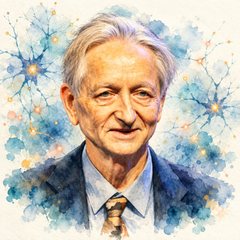
Geoffrey Hinton
Hinton's lab was an early CUDA user and he asked NVIDIA for a free GPU in 2009 (it said no); co-recipients of the 2024 VinFuture Grand Prize and 2025 Queen Elizabeth Prize for Engineering.
-
Ilya Sutskever
Trained AlexNet with Alex Krizhevsky on two NVIDIA GeForce cards in 2012, the result that turned NVIDIA toward deep learning.
-
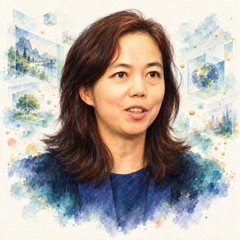
Fei-Fei Li
Co-recipient of the 2024 VinFuture Grand Prize and 2025 Queen Elizabeth Prize for Engineering; her ImageNet benchmark was the contest AlexNet won on NVIDIA GPUs, and both were on TIME's December 2025 cover.
-
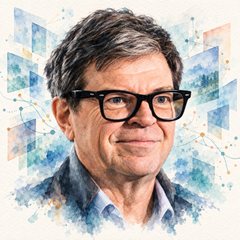
Yann LeCun
Co-recipient of the 2024 VinFuture Grand Prize and 2025 Queen Elizabeth Prize for Engineering; NVIDIA invested in his AMI Labs' March 2026 seed round, and both oppose restrictions on open-weight models.
-
Yoshua Bengio
Co-recipient of the 2024 VinFuture Grand Prize and 2025 Queen Elizabeth Prize for Engineering; on opposite sides of the catastrophic-risk debate.
-
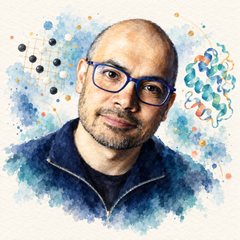
Demis Hassabis
Pictured with Huang on TIME's December 2025 "Architects of AI" cover; endorsed the September 2026 call to pace frontier AI that Huang rejected.
-
Gary Marcus
Marcus criticized Huang's September 2026 declaration that AGI had arrived as coming "with no evidence and no definitions."
-
Mustafa Suleyman
NVIDIA invested in the 1.3 billion dollar round Suleyman's Inflection AI raised in June 2023; in September 2026, as Huang argued against new AI laws, Suleyman said "Regulation is not a nasty, dangerous word."

Details and links
Organizations
- NVIDIA Co-founder, President and CEO, 1993-present
Education
- MS in Electrical EngineeringStanford University, 1992
- BS in Electrical EngineeringOregon State University, 1984
Affiliations
- NVIDIA (co-founder, president and CEO, 1993-)
- President's Council of Advisors on Science and Technology (member, 2026-)
- LSI Logic (engineer and director of CoreWare, 1985-1993)
- Advanced Micro Devices (microprocessor designer, 1984-1985)
- Jen-Hsun and Lori Huang Foundation (co-founder)
Areas of focus
Sources
- NVIDIA: Jensen Huang, board of directors biography
- NPR: Tech Pioneer Channels Hard Lessons Into Silicon Valley Success (February 20, 2012)
- The New Yorker: How Jensen Huang's Nvidia Is Powering the A.I. Revolution (Stephen Witt, November 27, 2023)
- Jensen Huang - Wikipedia (early life and awards; starting point only)
- CNBC: AI spending expected to top $1 trillion in 2 years. That estimate's way too low if Jensen Huang's right (May 21, 2026)
- Tom's Hardware: First Nvidia H200 shipments reach China (August 19, 2026)
- NVIDIA Form 8-K on A100 and H100 export license requirement (August 31, 2022)
- NVIDIA Form 8-K on H20 export license requirement (April 2025)
- NVIDIA Blog: NVIDIA CEO: Every Country Needs AI (February 12, 2024)
- White House: President Trump announces appointments to PCAST (March 2026)
- CNBC: Jensen Huang says U.S. chip restrictions have cut Nvidia's China market share nearly in half (May 21, 2025)
- Fortune: Nvidia's Jensen Huang says he disagrees with almost everything Anthropic CEO Dario Amodei says (June 11, 2025)
- Axios: Behind the Curtain, Jensen vs. Dario, "There will be more jobs" (July 14, 2025; archived copy)
- NVIDIA Q2 fiscal 2026 earnings call, corrected transcript (August 27, 2025)
- CNBC: Nvidia becomes first company to reach $5 trillion valuation (October 29, 2025)
- CNBC: Nvidia's Jensen Huang softens his 'China will win the AI race' remark to FT (November 6, 2025)
- Microsoft: Microsoft, NVIDIA and Anthropic announce strategic partnerships (November 18, 2025)
- CNBC: Trump greenlights Nvidia H200 AI chip sales to China if U.S. gets 25% cut (December 8, 2025)
- IEEE Spectrum: 2026 IEEE Medal of Honor Goes to Nvidia's Jensen Huang (January 2026)
- Semafor: Anthropic, China chip sales like 'selling nuclear weapons to N.Korea' (January 21, 2026)
- NVIDIA: Financial results for fourth quarter and fiscal 2026 (February 25, 2026)
- CNBC: Nvidia GTC 2026, Jensen Huang sees $1 trillion in orders for Blackwell and Vera Rubin through '27 (March 16, 2026)
- NVIDIA: Financial results for second quarter fiscal 2027 (August 26, 2026)
- CNBC: Nvidia CEO Jensen Huang emerges as Trump's top ally in AI safety debate (September 20, 2026)
- CBS News: Nvidia's Jensen Huang rejects AI extinction warnings as "doomsday narratives" (September 20, 2026)
- NVIDIA's Jensen Huang on the incredible future of AI - Stanford SIEPR (March 2024)
- Nvidia CEO Jensen Huang says AI could pass most human tests in five years - Fox Business (March 2024)
- Jensen Huang says you will lose your job to somebody who uses AI - CNBC (May 2025)
- Jensen Huang explains why Nvidia will grow an astounding 70% next year - TechCrunch (September 2026)
- 2025 Queen Elizabeth Prize for Engineering - Modern machine learning
- The 2024 VinFuture Prize honors four scientific works - VinFuture Prize, December 2024
- TIME: The Architects of AI Are TIME's 2025 Person of the Year (December 11, 2025)
- Statement on AI Risk - Center for AI Safety (signatories; Huang is not among them)
- Microsoft-backed AI startup Inflection raises $1.3 billion from Nvidia and others - Reuters via Yahoo Finance (29 June 2023)
Reading this to shape your organization's AI plans? Through EMX, I help leadership teams decide where AI fits, what to ignore, and what to build next—using the same vendor-neutral research behind this profile. Put the research to work