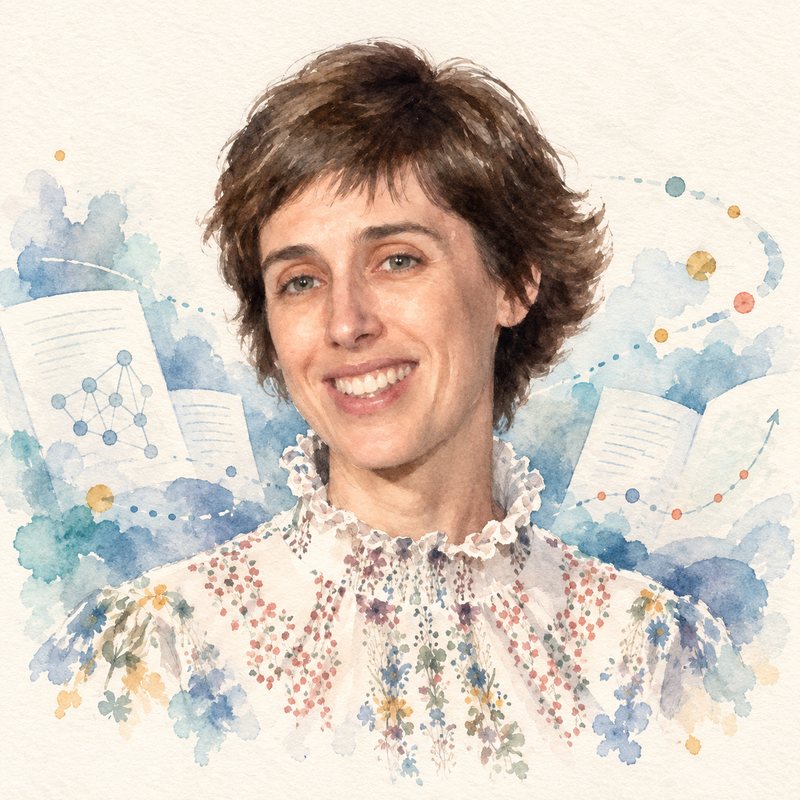
Joëlle Pineau
Chief AI Officer, Cohere
Ran Meta's FAIR lab from 2023 to 2025 and pushed its open releases; now chief AI officer at Cohere.
Joëlle Pineau trained as an engineer at the University of Waterloo and earned an MSc and PhD in robotics at Carnegie Mellon, then built a research group at McGill University on planning and learning under uncertainty, with applications in robotics and health care. She became known across the field for a procedural reform: as the first reproducibility chair of NeurIPS in 2019 she introduced a checklist that asks authors to supply code, data and experimental details with their submissions, and she started the ML Reproducibility Challenge.
Facebook hired her in 2017 to open its AI research lab in Montreal. She rose to managing director of Meta AI and argued inside the company for releasing work openly. When Meta released OPT-175B in May 2022, a GPT-3-sized model given to researchers with its code and a logbook of every crash in training, she told MIT Technology Review, "That commitment to open science is why I'm here. I wouldn't be here on any other terms." From early 2023 she led all of FAIR, the group that produced the first LLaMA models, reporting to Chief Product Officer Chris Cox.
On 1 April 2025, days before Llama 4's troubled launch, she announced she would leave on 30 May, writing that "it is time to create space for others to pursue the work." A Meta spokesperson called her "an important voice for Open Source," and in May the company named Rob Fergus, a FAIR co-founder, to succeed her. In August 2025 Cohere made her its first chief AI officer, in charge of research, product and policy, as it raised 500 million dollars at a 6.8 billion dollar valuation; she remains a McGill professor, on part-time leave. At Cohere she has pitched open models and customer-controlled deployments to businesses and governments, and TIME named her to its 2026 list of the 100 most influential people in AI.
Known for
The machine learning reproducibility checklist
Introduced at NeurIPS 2019, it asks authors to report code, data, compute and experimental settings, and was adopted in various forms by other major conferences.
OPT-175B and open research at FAIR
Championed Meta's 2022 release of a GPT-3-sized model with its training code and logbook, a precedent for the LLaMA release that FAIR made under her leadership in 2023.
On the record
Pineau has argued since at least 2022 that releasing models openly builds trust, and rejected the view that a model should be withheld because it is too dangerous.
“I believe the only way to build trust is extreme transparency”
Career
-
McGill University
Professor of Computer Science; co-director of the Reasoning and Learning Lab
-
Mila
Core academic member
-
2017-2025
Head of FAIR Montreal (2017), then Vice President of AI Research leading FAIR (2023 to 2025)
-
2025-present
Cohere
Chief AI Officer
Sources
- Joelle Pineau, home page and short bio (McGill University)
- Improving Reproducibility in Machine Learning Research (Pineau et al., arXiv, 2020)
- Meta has built a massive new language AI, and it's giving it away for free (MIT Technology Review, May 2022)
- Democratizing access to large-scale language models with OPT-175B (Meta AI, May 2022)
- Meta's head of AI research announces departure (CNBC, April 2025)
- Cohere hires long-time Meta research head Joelle Pineau as its chief AI officer (TechCrunch, August 2025)
- Yann LeCun on X announcing Rob Fergus as head of FAIR (May 2025)
- Joëlle Pineau, TIME100 AI 2026 (TIME, August 2026)
Brief profiles cover a person's professional record: roles, work and public statements, each from a source listed here. Full profiles, with positions across the debates, are kept for the people the site follows most closely.